
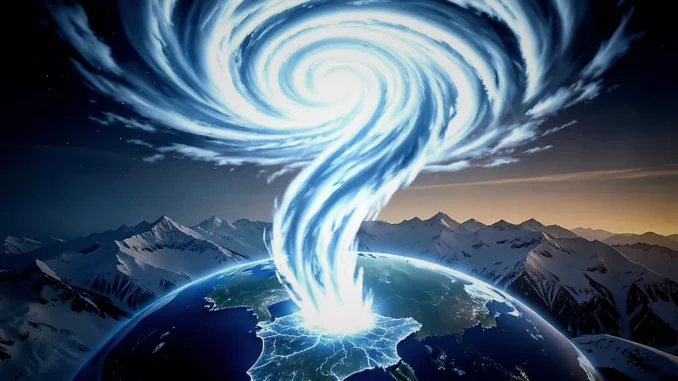
A sudden weakening of the stratospheric polar vortex can reshape weather patterns, but it does not automatically bring severe cold to every region. For Türkiye, the outcome depends largely on how the displaced cold air travels through the jet stream and whether it moves across the Balkans or toward western Europe and the North Atlantic.
Forecasts several weeks ahead remain uncertain. A disrupted vortex can raise the chance of cold spells, while the location, timing, and severity of any impacts depend on evolving atmospheric conditions.
What is the stratospheric polar vortex?
The stratospheric polar vortex is a large circulation of cold air and strong winds around the Arctic, high above the weather systems people experience at the surface. It typically strengthens during autumn and winter, helping keep much of the coldest polar air near the pole.
When atmospheric waves carry energy upward into the stratosphere, they can weaken or displace the vortex. A particularly strong warming event, known as a sudden stratospheric warming, may disrupt the circulation. Changes in the stratosphere can later influence the jet stream and surface weather, but the effects are neither immediate nor uniform.
Why can the vortex weaken unusually early?
Large atmospheric waves can rise from the troposphere into the stratosphere and transfer momentum and energy. If this transfer is strong, it can warm parts of the polar stratosphere, slow the vortex, and sometimes split or displace it. The resulting circulation changes may eventually affect weather patterns lower in the atmosphere.
The chain of events is not a direct forecast of a particular storm or cold wave. Forecasters must track whether the disruption persists, how it couples with the troposphere, and where the jet stream carries air masses.
Could a disrupted vortex bring cold weather to Turkey?
It could increase the possibility of cold spells, but the vortex disruption alone cannot determine whether Turkey will experience one. Two broad patterns illustrate why the route matters:
- Balkan route: If the jet stream steers cold air through eastern Europe and the Balkans, parts of Turkey could face colder conditions. Depending on moisture and local terrain, some areas might also see snow, strong winds, or icy roads.
- Western Europe or North Atlantic route: If the main cold-air outbreak moves toward western Europe or the North Atlantic, Türkiye may avoid the most significant cold. Its weather could instead remain closer to the prevailing regional pattern.
These are possible scenarios, not guaranteed outcomes. Even within Turkey, conditions can differ sharply between coastal areas, central plateaus, and eastern highlands.
Which parts of Turkey could be most exposed?
If a cold-air outbreak reaches the country, exposure will depend on the exact track, moisture supply, and elevation. Eastern Anatolia and the northeastern interior can be vulnerable to severe cold and heavy snow. Central Anatolia may experience prolonged frost or snow, while inland parts of the Black Sea region can face substantial snowfall and difficult travel.
Snowfall, blizzard conditions, and temperatures near any particular threshold cannot be inferred from a stratospheric event alone. Local forecasts become essential as the weather pattern develops.
When might the effects become clearer?
Weather impacts from a stratospheric disruption, if they develop, often take days to weeks to emerge at the surface. The exact lag varies, and not every disruption produces a strong, lasting response in surface weather.
Forecast confidence generally improves as the event draws closer. Outlooks made two or three weeks ahead can help identify broad trends, but they are not precise enough to promise a specific snowfall, temperature, or route into Türkiye. Short-range forecasts are more useful for decisions about travel and day-to-day safety.
What factors shape the winter pattern?
The polar vortex is only one part of the larger climate system. The jet stream, North Atlantic circulation, tropical atmospheric waves, and regional sea-surface temperatures can all influence where storms and cold air travel. El Niño may affect broad seasonal patterns, but it does not determine Turkey’s weather on its own.
A season can be relatively mild overall and still include brief, intense cold spells. Seasonal averages describe the general pattern; they do not rule out short-lived extremes.
How could a severe cold spell affect communities?
- Infrastructure: Freezing conditions can stress water pipes, power lines, and exposed equipment. Heavy snow and ice can complicate repairs.
- Agriculture: Frost may damage vulnerable crops, while snow and freezing temperatures can affect greenhouses and livestock operations.
- Transport: Snow and ice can disrupt road, rail, and air travel, particularly on high-elevation routes and in areas with limited alternative access.
- Health: Prolonged exposure to cold can worsen respiratory and cardiovascular conditions and increase the risk of hypothermia.
Practical steps to prepare for winter weather
- Follow official weather warnings and check updated forecasts before travelling.
- Keep essential medicines, drinking water, food, warm clothing, and a charged power bank available at home.
- Insulate exposed pipes and learn how to shut off the water supply if a pipe freezes.
- Use heating equipment safely and maintain working smoke and carbon-monoxide alarms where applicable.
- Plan alternative routes and allow extra travel time when snow or ice is forecast.
- Local authorities and essential-service operators can review snow-clearing plans, backup power, emergency communications, and support for people who may need help staying warm.
Frequently asked questions
Does a polar vortex disruption mean Turkey will get snow? No. It can alter the odds of cold weather, but snow depends on the air-mass track, moisture, temperature, and local conditions.
Why can one region turn cold while another stays mild? Jet-stream patterns and surface pressure systems steer cold air along particular routes. A disruption can therefore affect different regions in different ways.
How far ahead can forecasters predict a cold outbreak? Broad patterns may become clearer in extended outlooks, but specific local impacts are more dependable closer to the event. Forecast updates should be checked regularly.
Where should people check for reliable updates? Use Türkiye’s official meteorological service and other established national weather services. Compare current forecasts and warnings rather than relying on a single long-range model run.
What to watch next
The key question is not simply whether the stratospheric vortex weakens, but whether that disruption influences the lower atmosphere and steers cold air towards Turkey. Until the route becomes clearer, a cold outbreak remains a possibility rather than a certainty. Monitor official forecasts for developments in the jet stream, regional pressure patterns, and local warnings.









Be the first to comment