
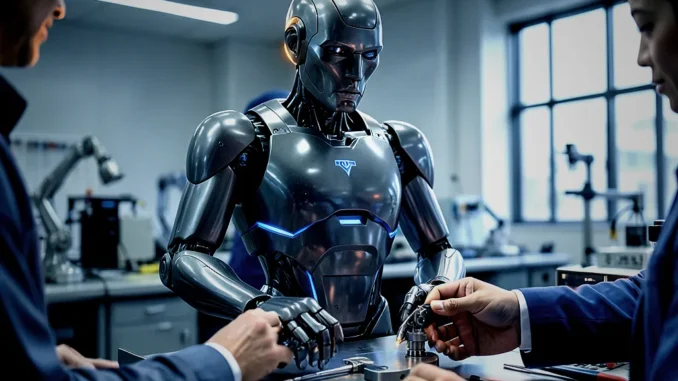
Meta and Chinese robotics company Fourier reportedly developed a working humanoid robot prototype in about three months and have begun work on a second version. The reported collaboration combines Meta’s artificial intelligence and visual-processing capabilities with Fourier’s experience in robotics hardware and mechanical design. The prototypes are described as research platforms, not products available for purchase.
What did Meta and Fourier develop?
According to reports attributed to Reuters, the companies built an initial humanoid robot prototype and moved on to a second iteration. The reported development focused on human-like movement and basic task performance, including walking on flat surfaces, handling simple objects, and responding to basic commands.
The partnership reflects a division of expertise: Meta reportedly contributed AI and computer-vision technology, while Fourier worked on the robot’s mechanical structure, actuators, and physical prototypes. The companies have not publicly confirmed every reported technical detail, so descriptions of specific features should be treated as provisional unless verified through an official announcement.
What capabilities have been reported?
Reports describe early-stage abilities such as stable walking on level ground, simple object handling, and basic interaction with people. These are common milestones in humanoid robotics: a robot must perceive its environments, plan a movement, and coordinate multiple motors while maintaining balance.
Some accounts have also referred to sensors such as cameras and LIDAR, as well as pressure-sensitive fingertips. These details have not been independently confirmed in a complete technical specification. In general, cameras help a robot identify objects and surroundings, LIDAR can measure distance, and fingertip sensors can help it detect contact when grasping an item.
Why are the robots reportedly not for sale?
The prototypes are reportedly intended for research and development rather than commercial sale. That distinction matters because a demonstration robot does not necessarily meet the requirements for a dependable product. Before companies can sell humanoid robots at scale, they typically need to improve reliability, safety, operating time, maintenance, and manufacturing costs.
Regulatory requirements and supply-chain considerations may also affect commercialization, particularly when a project involves companies based in different countries. However, without an official explanation from Meta or Fourier, the precise reasons for keeping the prototypes off the market remain unconfirmed.
How could US national security rules affect the partnership?
US policy discussions about robotics and industrial machinery can influence imports, technology transfers, and partnerships involving foreign companies. Depending on the specific rules adopted, companies could face additional reviews, licensing requirements, or restrictions on certain components and transactions.
A policy statement alone does not establish that a particular company or project is prohibited. The practical effect depends on the final rules, the equipment involved, the parties to a transaction, and how regulators interpret the relevant requirements. Any claim that the reported partnership has already been restricted would need specific supporting evidence.
What has Reuters confirmed?
Reuters reportedly cited sources familiar with the project, but the details were not immediately confirmed. When a project remains private, outside verification can be difficult: companies may decline to comment, prototypes may not be publicly demonstrated, and technical specifications may not appear in filings or publications.
Readers can assess future claims by looking for direct statements from Meta or Fourier, public demonstrations, patents, technical papers, or corroborating reports from other established news organizations. Until then, reported specifications and explanations should be distinguished from confirmed facts.
What could the collaboration mean for robotics?
If the reported arrangement continues, it could bring together large-scale AI development and specialized robotics engineering. That combination may help teams test how perception and software work with a robot’s physical body, while shortening the cycle between design changes and hardware trials.
The collaboration could also illustrate a broader industry pattern: technology companies may develop AI systems while robotics specialists build the machines that run them. At the same time, cross-border partnerships may need to account for export rules, supply-chain, and access to specialized components.
What should observers watch next?
- Official statements: Look for announcements from Meta or Fourier that confirm the project, its goals, or its technical details.
- Public demonstrations: Video or live demonstrations could show whether the robots can walk, grasp objects, and respond reliably outside controlled tests.
- Technical disclosures: Patents, research papers, and engineering presentations may clarify the hardware and software involved.
- Regulatory developments: Final rules on robotics imports or technology transfers would provide more concrete information than broad policy statements.
- Commercial plans: A pilot program, production announcement, or customer deployment would indicate whether the work is moving beyond research.
For now, the reported Meta–Fourier effort appears to is an early-stage robotics project. Its significance will become clearer if the companies confirm the prototypes, demonstrate repeatable capabilities, or outline a path from research to practical deployment.







Be the first to comment