
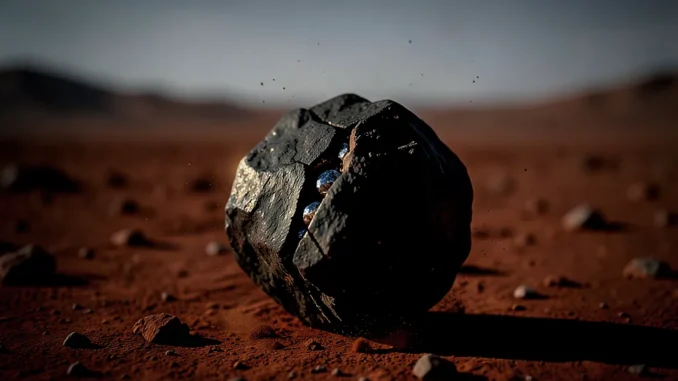
Teghaza 001 is a Martian meteorite discovered in the Sahara Desert in 2022. Weighing about 800 grams, it preserves evidence of Mars’s ancient crust and later interaction with liquid water. Researchers estimate that water altered minerals in the rock around 4.1 billion years ago, offering a rare record of conditions on early Mars.
What is Teghaza 001?
Teghaza 001 is a meteorite that originated on Mars and eventually reached Earth after being blasted from the planet’s surface by an impact. Its mineral composition identifies it as Martian, while its unusually ancient geological record makes it valuable for studying the planet’s early crust.
The rock formed through magmatic processes, then experienced later mineral alteration associated with liquid water. That combination lets scientists investigate both how early Martian crust formed and how water changed it afterward.
How old is Teghaza 001?
Researchers place the water-related alteration recorded in Teghaza 001 at approximately 4.1 billion years ago. This date refers to the alteration event, not necessarily the meteorite’s original formation. The rock’s minerals preserve evidence of an earlier magmatic history as well as this later interaction with water.
Scientists establish such timelines by examining minerals and measuring radioactive isotope systems. In methods such as uranium–lead dating, researchers compare parent isotopes with the stable products they decay into. Mineral chemistry and microscopic textures then help distinguish the age of the rock’s formation from the age of later alteration.
What does the meteorite reveal about water on Mars?
Teghaza 001 shows that liquid water interacted chemically with Martian rock early in the planet’s history. Water can dissolve or modify some minerals and produce new mineral phases, leaving textures and chemical signatures that survive long after the original fluid disappears.
The meteorite does not, by itself, establish how widespread or long-lasting that water was. It does provide direct evidence that water-related alteration occurred in the ancient Martian crust. Comparing this sample with other Martian meteorites and surface measurements can help researchers determine whether similar processes occurred in many locations or in specific environments.
How do scientists study Teghaza 001?
- Prepare the sample: Researchers cut and polish small sections while limiting contamination.
- Identify minerals: Microscopy and analytical instruments reveal the minerals present and their relationships.
- Measure chemical composition: Elemental Analyzes show how the rock’s chemistry between varies minerals and altered regions.
- Determine ages: Suitable minerals are analyzed with radiometric dating techniques to estimate when they formed or changed.
- Reconstruct the history: Scientists combine the dates, mineral textures, and chemical evidence to distinguish magmatic formation from later water-driven alteration.
Why is Teghaza 001 important?
Most information about Mars comes from spacecraft observations, but meteorites provide physical material That scientists can analyze in laboratories on Earth. Teghaza 001 offers a close-up record of ancient Martian minerals and their chemical history.
Its evidence can help refine models of early Mars by showing that the planet’s crust experienced both igneous processes and later interaction with liquid water. Those findings also help researchers decide which ancient rocks and altered terrains future Mars missions should prioritize when searching for preserved signs of past environments.
What questions remain?
- Where did the water come from? The meteorite’s evidence does not alone reveal whether the fluid came from local melting, groundwater, or another source.
- How long did the alteration last? Mineral changes record water interaction, but determining its duration and number of episodes requires further analysis.
- How common was the process? Comparing Teghaza 001 with other samples can show whether similar alteration affected a broad region of Mars or a more limited setting.
- Could the minerals preserve signs of habitable conditions? Altered minerals may help identify ancient chemical environments, although evidence of water is not evidence of life.
What Teghaza 001 tells us about ancient Mars
Teghaza 001 preserves evidence that Martian rock formed through magmatic activity and later interacted with liquid water. The alteration is dated to about 4.1 billion years ago, making the meteorite a useful record of early crustal processes. Further comparison with other Martian samples will help establish where the water acted, how long it persisted, and how it shaped the planet’s ancient surface.










Be the first to comment