
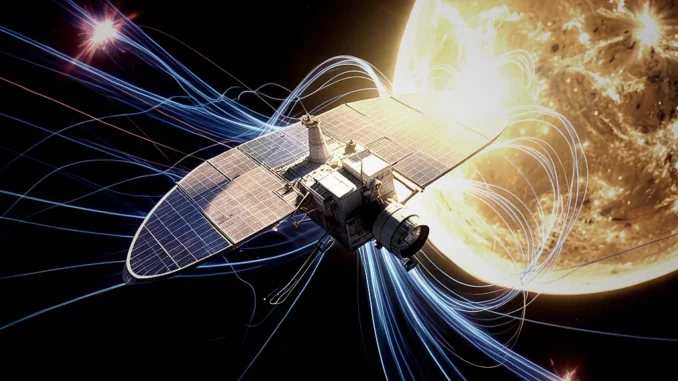
Parker Solar Probe measurements reveal an organized pattern within solar-wind turbulence: magnetic-field rotations change direction across different spatial scales. The finding offers a direct observational link between large-scale, fluid-like plasma behavior and the particle-scale processes that shape turbulence near the Sun.
What did Parker Solar Probe discover?
The probe detected opposite magnetic-field rotation tendencies at large and small scales. In the reference frame used by the study, large-scale structures tended to rotate counterclockwise, while smaller-scale fluctuations tended to rotate counterclockwise. Rather than behaving as entirely random noise, the turbulent magnetic field showed a scale-dependent preference.
The result matters because turbulence transfers energy from larger structures towards smaller ones. A change in rotation across that transfer may help identify where fluid-like descriptions give way to kinetic effects—the behavior of individual charged particles.
How did researchers identify the pattern?
Researchers analyzed Parker Solar Probe’s high-resolution electric- and magnetic-field measurements. They used spectral and statistical methods to compare field behavior across scales, including wavelet analysis, cross-correlation, and measures of rotational direction. Comparing observations at different distances from the Sun also revealed how the characteristic scale of the reversal changes as the solar wind travels outward.
- Select measurements: Use magnetic- and electric-field records, alongside available plasma density and velocity data.
- Prepare the data: Synchronize measurements and reduce noise and edge effects.
- Separate scales: Apply wavelet methods to examine fluctuations at different characteristic sizes.
- Measure rotation: Calculate scale-dependent field statistics to determine preferred rotational direction.
- Compare distances: Test whether the reversal shifts as the solar wind moves away from the Sun.
- Check significance: Use statistical tests, such as permutation and bootstrap methods, to assess whether the pattern is consistent with random fluctuations.
How does the reversal change with distance from the Sun?
The characteristic scale associated with the change in rotation becomes larger farther from the Sun. The study describes a shift from scales of a few hundred kilometers in some near-Sun conditions toward scales of thousands of kilometers farther out. These values illustrate the reported trend; the precise scale depends on the sampled conditions and analysis.
This outward evolution suggests that the turbulent structures develop as the solar wind expands. It also gives researchers a way to test models: a model should reproduce not just the reversal itself, but how its characteristic scale changes with distance.
Why does a change in magnetic-field rotation matter?
Magnetic-field orientation helps scientists understand how turbulent energy moves and dissipates. At larger scales, plasma often behaves approximately like a conducting fluid. At smaller scales, particle motion—including magnetic deflection and gyromotion—becomes increasingly important. A shift in rotation can therefore mark a transition between different physical regimes.
That transition may influence how energy heats the solar wind, how particles gain speed, and how magnetic reconnection proceeds. The observation does not, by itself, establish one specific heating mechanism. Instead, it provides a measurable constraint that theories of plasma turbulence and particle-scale energy transfer need to explain.
What could this mean for space weather?
Solar-wind turbulence can alter the structure of shocks and magnetic clouds traveling through interplanetary space. When these structures reach Earth, their magnetic-field orientation and variability help determine how they interact with the magnetosphere. Better descriptions of turbulence could therefore improve the way forecasting models represent magnetic structures and their possible effects.
For example, improved turbulence models may help researchers estimate how an incoming solar event evolves before it reaches Earth. That information is relevant to satellite operations, radio communications, and power-grid planning, although this study does not provide a stand-alone forecast of any particular space-weather event.
What are the study’s limitations?
A spacecraft measures conditions along its path, so a single probe cannot capture every spatial feature at once. Separating changes over time from changes across space also remains a challenge in turbulence research. The observations provide evidence for a scale-dependent pattern, but explaining its microscopic cause requires further measurements and modeling.
Future work can compare coordinated observations from multiple spacecraft, test different solar-wind conditions such as fast and slow flows, and connect the measurements with high-resolution kinetic simulations. Laboratory plasma experiments may also help researchers examine whether the same scale-dependent rotation appears under controlled conditions.
Key takeaway
Parker Solar Probe found that magnetic-field rotations in solar-wind turbulence can favor opposite directions at large and small scales. The reversal’s characteristic scale also grows with distance from the Sun. Together, these observations give plasma-physics models a specific pattern to explain and may eventually improve descriptions of how solar-wind structures evolve on their way to Earth.








Be the first to comment