
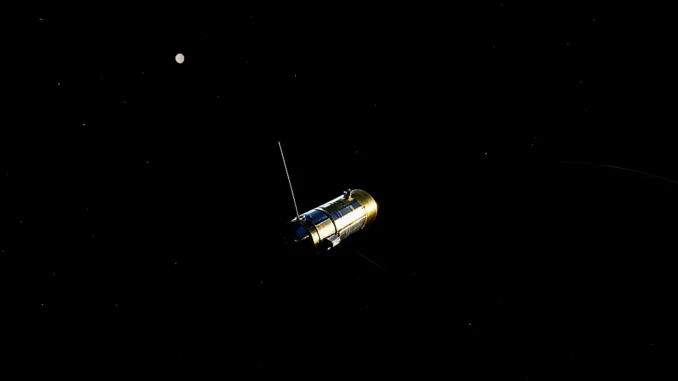
Launched in 1977, Voyager 1 has transformed our understanding of the outer planets and the space beyond the Sun’s influence. It revealed active volcanoes on Jupiter’s moon Io, examined Saturn and Titan, and became the first spacecraft to enter interstellar space. Its long-running measurements still help scientists study the boundary between the heliosphere and the wider galaxy.
Why did NASA launch Voyager 1?
NASA designed the Voyager missions to explore the outer planets during a rare alignment that allowed spacecraft to travel efficiently between them. Voyager 2 launched on August 20, 1977, and Voyager 1 followed on September 5. Despite its name, Voyager 1 took the faster route to Jupiter and Saturn, using each planet’s gravity to redirect and accelerate its journey.
What did Voyager 1 discover at Jupiter and Saturn?
During its March 1979 Jupiter encounter, Voyager 1 documented the planet’s turbulent atmosphere, faint rings, and complex magnetic environment. It also discovered active volcanoes on Io, providing the first direct evidence of volcanic activity beyond Earth. The spacecraft identified Jupiter’s moons Thebe and Metis as well.
Voyager 1 passed Saturn in November 1980 and gathered detailed observations of its rings, atmosphere, and moons. Its measurements of Titan’s thick atmosphere helped establish the moon as a major target for later exploration, including the Cassini-Huygens mission.
When did Voyager 1 enter interstellar space?
Voyager 1 crossed the heliopause on August 25, 2012, becoming the first spacecraft to enter interstellar space. The heliopause marks the outer boundary of the heliosphere, the vast region shaped by the solar wind and the Sun’s magnetic influence.
Beyond that boundary, Voyager 1 measured changes in charged particles and plasma conditions. These observations gave scientists direct data from an environment that had previously been studied mainly through models and indirect evidence.
What data does Voyager 1 still send to Earth?
Voyager 1 continues to provide measurements from its distant location, including data on magnetic fields, plasma waves, and cosmic rays. Scientists use these records to track how the interstellar environment changes over time and how the heliosphere interacts with it.
- Plasma and plasma waves: Wave measurements help researchers estimate the density of interstellar plasma.
- Magnetic fields: The spacecraft records field strength and direction near the heliosphere’s outer boundary.
- Cosmic rays: Particle counts help scientists distinguish changes associated with the Sun from those originating elsewhere in the galaxy.
- Long-term trends: Decades of observations allow researchers to compare conditions across different periods of solar activity.
Voyager 2 entered interstellar space in 2018. Comparing its measurements with Voyager 1’s scientists gives observations from two separate locations, helping them investigate whether the heliosphere has a consistent shape or varies across its boundary.
What is the Golden Record?
Voyager 1 carries a 30-centimeter gold-plated copper record intended as a message from Earth. It contains 115 encoded images, greetings in 55 languages, natural sounds, and music. The selection combines scientific and cultural material, including works by composers such as Bach and Mozart alongside Chuck Berry’s music.
The record’s images and sounds offer a snapshot of life on Earth, while its cover includes instructions intended to explain how to play it. The record is a cultural artifact carried aboard a spacecraft whose primary mission was scientific exploration.
Why is Voyager 1’s mission difficult to maintain?
Voyager 1 relies on radioisotope thermoelectric generators, which produce electricity from the heat released by decaying plutonium-238. Their power output declines over time. NASA has responded by turning off instruments and heaters in stages, preserving enough power for selected science observations and communications.
Distance creates another challenge. Radio signals take many hours to travel between Earth and the spacecraft, so engineers cannot rely on quick, back-and-forth troubleshooting. They must plan commands carefully and account for the delay before receiving a response.
How does NASA extend Voyager 1’s operating life?
Engineers use several practical strategies to conserve power and reduce operational risk:
- Turn off lower-priority equipment: NASA can shut down instruments or components when their power cost outweighs their remaining scientific value.
- Schedule operations carefully: Command sequences account for long communication delays and the spacecraft’s limited energy supply.
- Manage heat: Engineers monitor temperature-sensitive systems and use available power to protect essential hardware when needed.
- Prioritize data: The team focuses on measurements that Voyager’s distant position can uniquely provide.
How does Voyager 1 influence future space missions?
Voyager 1’s experience informs the design of missions that may operate far from the Sun. Its declining power output highlights the need for realistic energy budgets, while its long communication delays show why distant spacecraft need reliable onboard systems, stored commands, and efficient data handling.
Its measurements also improve models of the heliosphere and interstellar space. Future mission planners can use those findings to choose instruments, estimate power needs, and determine how spacecraft should operate beyond the planets.
What is Voyager 1’s lasting significance?
Voyager 1 linked landmark planetary encounters with the first direct measurements from interstellar space. Its observations of Jupiter, Saturn, Titan, and the heliosphere’s outer boundary continue to support research in planetary science and space physics. Even as its power declines, the spacecraft’s location and decades-long record remain scientifically valuable.







Be the first to comment