
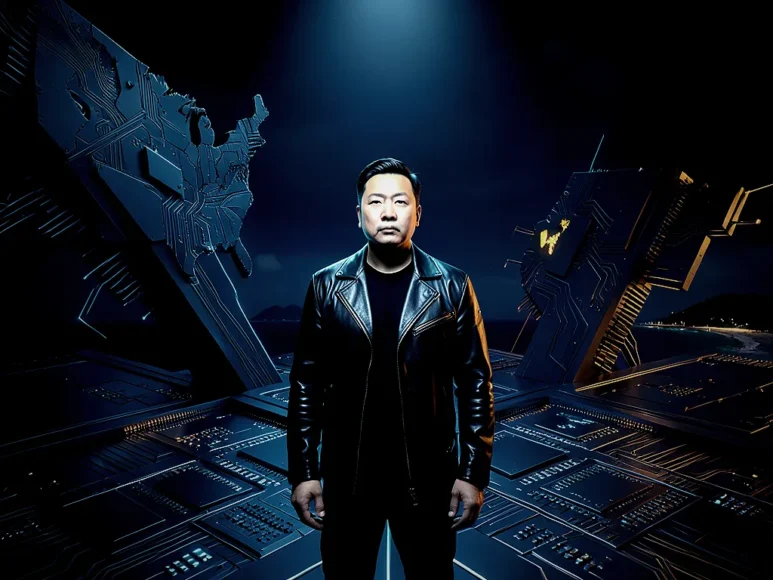
Jensen Huang’s leadership at Nvidia sits at the intersection of artificial intelligence, semiconductor manufacturing and geopolitical competition. Nvidia designs powerful graphics processing units (GPUs), while specialist manufacturers—most notably Taiwan’s TSMC—produce many of its advanced chips. This division of work helped Nvidia grow without building its own chip factories, but it also tied the company’s supply chain to a strategically important region.
Who is Jensen Huang?
Jensen Huang co-founded Nvidia in 1993 and has led the company through its evolution from a graphics-chip maker into a major supplier of computing platforms for artificial intelligence and data centers. Nvidia combines GPU hardware with CUDA, its software platform for programming compatible processors. Together, these products give developers a reason to build and maintain applications within Nvidia’s ecosystem.
Why does Taiwan matter to semiconductor production?
Taiwan became central to the global chip industry by specializing in contract manufacturing. TSMC’s foundry model lets companies such as Nvidia design chips without owning the factories that manufacture them. This arrangement gives chip designers access to advanced production capabilities while allowing the foundry to serve many customers and spread the enormous cost of fabrication facilities across a broad business.
- For chip designers: Outsourcing fabrication reduces the need to invest directly in expensive factories.
- For TSMC: Manufacturing for multiple customers creates scale and deep production expertise.
- For global supply chains: Concentrated advanced-chip production creates efficiency, but also exposes customers to regional disruption.
Nvidia’s reliance on Taiwanese manufacturing illustrates this trade-off: the arrangement supports access to advanced production, yet makes supply-chain resilience a strategic concern for the company and governments.
How do US export controls affect Nvidia’s business in China?
US export controls restrict the sale of certain advanced computing chips and related technologies to China because of national-security concerns. Nvidia has sought to serve the Chinese market with products designed to comply with applicable limits. When rules change or cover additional products, however, the company may have to revise its offerings or lose access to customers.
The commercial stakes are significant. The supplied material reports that China accounted for about 14% of Nvidia’s revenue in fiscal 2025, or approximately $17.1 billion. That figure helps explain why restrictions create a business challenge: Nvidia must weigh potential sales against regulatory uncertainty and the risk that products could be used in ways the US government seeks to prevent.
What is CUDA, and why does it matter?
CUDA is Nvidia’s software platform for developing applications that run on its GPUs. Developers who have built tools and workflows around CUDA may face extra time and expense when moving those applications to another hardware platform. As a result, Nvidia competes not only through chip performance but also through the software, libraries and developer practices surrounding its products.
This ecosystem can make it difficult for Competitors to win customers, even when they offer alternative processors. It also means that access to hardware is only one part of the competitive picture: software compatibility, developer support and the cost of switching platforms can shape adoption in data centers.
How do the United States, Taiwan and China approach semiconductor competition?
- United States: Uses export controls and domestic-investment incentives to limit certain technology transfers and encourage more manufacturing capacity at home.
- Taiwan: Seeks to sustain its manufacturing leadership while managing international partnerships and the risks associated with concentrated production.
- China: Invests in domestic semiconductor capabilities and pursues greater technological independence, while using policy tools that support strategic industries.
These approaches interact. US restrictions may limit China’s access to particular advanced chips, while also strengthening incentives for Chinese companies to develop domestic alternatives. Taiwan’s manufacturing position remains valuable to global customers, but that concentration also makes diversification a priority.
Why has Jensen Huang’s public role attracted political attention?
As the head of a company at the center of AI and chip supply chains, Huang’s comments and travel plans can draw scrutiny from policymakers. The supplied material cites a June 2024 reference to Taiwan as a “country” that drew a negative response from Beijing. It also describes criticism from US senators over a planned July 2025 visit to China, with concerns focused on exports and national security.
Such episodes show how the chief executive of a technology company can become part of a wider diplomatic debate. Nvidia’s commercial relationships span markets whose governments have competing priorities, so corporate decisions can carry consequences beyond sales and product development.
What strategic choices does Nvidia face?
Nvidia must balance access to the Chinese market against US rules and the possibility of unintended technology transfers. Huang has argued that restrictions could encourage China to accelerate development of its own chips, potentially reducing the long-term position of US firms. Critics, by contrast, focus on the security risks of continuing to supply advanced computing technology.
The company’s challenge is to manage both sides of this equation: comply with regulations while maintaining its competitive position, and reduce supply risks without sacrificing access to critical manufacturing expertise.
How can Nvidia strengthen its resilience?
- Diversify supply-chain stages: Develop additional sources and partnerships for packaging, testing and other production steps where practical.
- Build adaptable products: Design product portfolios that can respond efficiently to different regional rules.
- Support software interoperability: Continue improving CUDA while considering standards and tools that can broaden customer flexibility.
- Coordinate on compliance: Work with regulators and customers to clarify product requirements and manage export-control risks.
These steps cannot quickly replace the advanced manufacturing capacity concentrated in Taiwan. They can, however, help Nvidia reduce exposure to individual bottlenecks and respond more effectively when regulations or market conditions shift.
What is the outlook for Nvidia and the semiconductor industry?
In the near term, Taiwanese manufacturing is likely to remain an essential part of advanced-chip supply, while export controls continue to shape Nvidia’s access to China. Over time, competition may increasingly depend on software ecosystems as well as processors: a rival needs not only capable hardware but also the tools, developer support and customer adoption required to make that hardware useful at scale.
Nvidia’s position therefore rests on three connected strengths and risks: its GPU technology, its CUDA ecosystem and its access to a complex global supply chain. The company’s ability to adapt across all three will influence its future growth—and the broader balance of power in the semiconductor industry.