
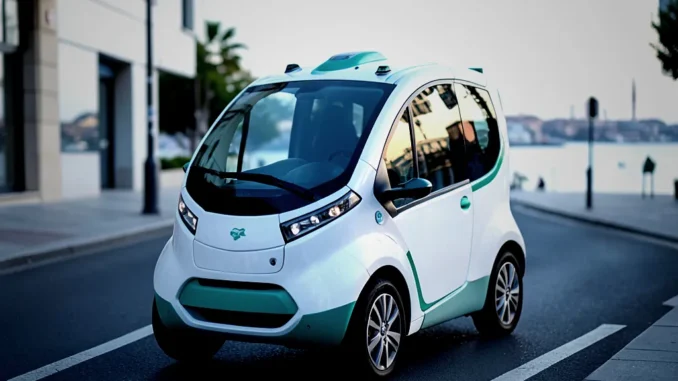
RoboMartı is a proposed urban mobility service that combines self-driving vehicles with shared, on-demand rides. Its vehicles use cameras, lidar, and radar to interpret the road, while artificial intelligence helps plan routes and respond to changing traffic conditions. By grouping compatible trips, the service could reduce the number of vehicles needed to carry passengers traveling in similar directions.
What is RoboMartı?
RoboMartı brings together an autonomous fleet vehicle and a ride-sharing platform. Passengers request trips through an app, and the system matches requests with available vehicles. Rather than sending a separate car for every passenger, it can group people whose journeys overlap and plan a route with multiple pickups or drop-offs.
The concept depends on more than self-driving technology. It also requires fleet management, passenger support, secure payment, vehicle maintenance, and coordination with local transport authorities. The quality of the service depends on how well these parts work together.
How does RoboMartı work?
A RoboMartı vehicle follows a continuous process: it senses its surroundings, interprets incoming data, chooses a safe action, and controls the vehicle. Cameras identify visual details such as lane markings and traffic lights. Lidar measures the distance and shape of nearby objects, while radar helps estimate distance and speed, including in conditions where visibility is reduced.
Onboard software combines these sensor readings to estimate the vehicle’s position and understand nearby road users. It then selects a driving behavior, such as maintaining speed, slowing down for a pedestrian, or changing lanes when safe. The control system turns that decision into steering, acceleration, and braking commands.
Which sensors do autonomous vehicles use?
- Cameras: Capture color and visual details, including signs, signals, road markings, and pedestrians.
- Lidar: Produces distance measurements that help the vehicle map nearby objects and road geometry.
- Radar: Measures the range and relative speed of objects and can provide useful readings when visibility is poor.
Combining these sensors helps reduce reliance on any single source of information. For example, a camera may identify a traffic signal, while lidar and radar help the vehicle estimate the positions and movement of nearby vehicles. Sensor fusion does not eliminate risk, so systems still need to detect uncertainty and respond cautiously.
How does the vehicle make driving decisions?
The driving software typically handles perception, localization, planning, and control. Perception identifies and tracks road users. Localization estimates the vehicle’s position using sensor data and map information. Planning selects a route and determines how the vehicle should behave along it. Control applies the planned motion through steering, acceleration, and braking.
Consider a pedestrian approaching a crossing. The system first detects and tracks the person, then estimates whether they may enter the vehicle’s path. The planner can respond by slowing down or stopping, and the control system carries out that response. Developers test these steps together because a correct detection is useful only if the vehicle acts on it appropriately.
How does shared-ride matching work?
When passengers request rides, the platform compares their destinations, pickup points, arrival needs, and available vehicle capacity. It can group trips when sharing a vehicle does not create an unacceptable detour or delay. The routing system then updates the sequence of pickups and drop-offs as new requests arrive or traffic changes.
For example, three passengers traveling toward the same business district might share one vehicle if their routes overlap. The service must balance vehicle occupancy against waiting time and total journey time. Dynamic pricing may also help manage demand, but its usefulness depends on clear rules and predictable fares for passengers.
How are RoboMartı vehicles tested for safety?
A responsible testing program can progress from software simulation to controlled physical testing and, where permitted, limited public-road pilots. Simulations let developers examine many road situations efficiently, including rare events that would be difficult to reproduce safely. Closed-course tests help verify vehicle behavior in a controlled setting, while supervised pilots reveal how the system performs amid real traffic and road conditions.
Operators can strengthen safety processes through software version control, documented test results, incident reporting, and procedures for reverting a release if a problem appears. Emergency-stop controls and remote or onboard supervision may also form part of an operating plan. The specific safeguards depend on the vehicle design, local rules, and the conditions under which the service runs.
What would passengers experience?
Passengers would use an app to request a trip, review pickup details, see an estimated arrival time, and follow the route. Before departure, the service should explain how to enter and exit the vehicle and how to request help. Clear in-vehicle instructions and an accessible emergency contact method can make the experience easier to understand.
Payment options could include single-ride fares, subscriptions, or employer-sponsored travel. The platform should explain how it calculates fares, handles cancellations, and manages shared-trip detours. It should also limit access to personal information and communicate how it stores and uses journey data.
How could RoboMartı connect with public transport?
Shared autonomous vehicles could support public transport by serving short trips to and from stations or connecting neighborhoods with limited transit access. Useful integration would require coordinated pickup locations, reliable connections, and fare or journey-planning options that make transfers straightforward. Cities would also need to plan for vehicle staging, charging, curb access, and the effects of additional pickups on traffic.
Any impact on congestion or emissions would depend on real operating conditions. Shared rides could reduce vehicle trips when passengers genuinely travel together or replace individual car journeys. They could have the opposite effect if vehicles spend substantial time traveling empty or draw passengers away from high-capacity public transport.
What are the main costs and business models?
Costs include vehicle acquisition, sensors, software development, charging, maintenance, insurance, fleet operations, and customer support. Possible revenue sources include ride fares, subscriptions, contracts with employers, and partnerships with local organizations. Sharing can lower the cost per passenger when vehicles achieve strong occupancy, but low utilization and empty repositioning can undermine that advantage.
Operators therefore need to track practical measures such as wait time, passenger occupancy, vehicle availability, trip completion, energy use, and maintenance needs. These figures help determine whether a route or operating area can support a reliable service.
What challenges could RoboMartı face?
- Technical reliability: Vehicles must handle varied road layouts, weather, construction, and interactions with other road users.
- Cybersecurity: Fleet systems and vehicle communications need protection against unauthorized access and disruption.
- Legal responsibility: Regulators and operators must define responsibilities for testing, investigations, insurance, and public-road operation.
- Infrastructure: Charging, pickup zones, maps, road markings, and traffic systems can affect service performance.
- Passenger trust and access: The service needs clear instructions, dependable support, accessible vehicles, and transparent policies.
Operators can address these challenges through staged testing, security reviews, clear incident procedures, and close coordination with transport authorities. Pilot programs should define where vehicles can operate, what supervision is required, and how performance will be reviewed before expansion.
How could a RoboMartı pilot begin?
- Select a suitable area. Assess road conditions, demand, charging access, public transport links, and local approval requirements.
- Consult stakeholders. Coordinate with municipal authorities, transport agencies, emergency services, energy providers, and nearby businesses.
- Validate the technology. Test perception, routing, vehicle control, and safety responses in simulation and controlled facilities.
- Run supervised road tests. Begin with limited routes and defined operating conditions, then review performance and incidents.
- Launch a small passenger pilot. Set clear service hours, pickup locations, support channels, and passenger eligibility.
- Measure and refine. Use operational data and passenger feedback to improve routes, dispatch, safety procedures, and service design.
- Expand cautiously. Add vehicles or service areas only when results support reliable operations and local requirements are met.
What is RoboMartı’s potential?
RoboMartı’s potential rests on combining autonomous driving with efficient trip sharing, rather than treating either feature as a complete transport solution on its own. A carefully managed service could offer convenient local trips and help connect passengers with transit. Its actual effects on cost, traffic, access, and emissions would need to be established through transparent pilots and measured against local conditions.







Be the first to comment