
Ancient seabed deposits in China’s Sichuan Basin preserve evidence that tropical storms intensified in a recurring cycle about every 405,000 years. Researchers identified the pattern in Cambrian rocks formed roughly 24 million years of geological time ago. The deposits do not record individual storms in modern detail, but their repeated layers offer clues to long-term changes in storm activity and the climate conditions that may have driven them.
What the Cambrian rock layers reveal
Powerful waves and currents can disturb sand, silt, and mud on the seafloor. When this material settles, it can form storm-generated sediment layers called tempestites. Geologists study features such as grain size, layer thickness, sedimentary structures, and fossils to distinguish these deposits and reconstruct past marine conditions.
In the Sichuan Basin, researchers examined thousands of sedimentary layers. Changes in the abundance and characteristics of tempestites appear repeatedly through the rock sequence, providing a record of shifts in storm activity. The layers act as an indirect climate archive: they preserve sediment moved by storms rather than the storms themselves.
How researchers identified the 405,000-year cycle
The research team used cyclostratigraphy, a method that identifies recurring patterns in sedimentary rocks and compares them with known or calculated climate cycles. They assessed the sequence over an interval of about 24 million years and identified 59 repeated units. Each unit represents an average interval of roughly 405,000 years.
Researchers evaluated the timing alongside sedimentary evidence, including changes in tempestite frequency and grain-size patterns. They also considered geochemical signals, such as variations in carbon and oxygen isotope ratios, which can provide information about past ocean and climate conditions. Together, these observations support a recurring climate signal, although they do not establish that orbital changes alone caused every variation in storm deposits.
Why a 405,000-year orbital cycle matters
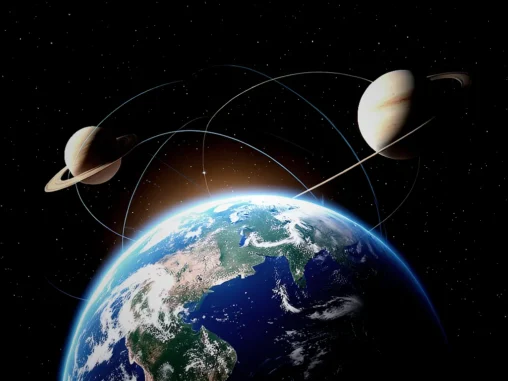
Earth’s orbit changes shape over time, a variation known as eccentricity. One prominent eccentricity cycle lasts about 405,000 years. The long-term rhythm is associated with gravitational interactions among the planets, including Venus and Jupiter, which influence Earth’s orbit.
Changes in eccentricity do not necessarily cause a large change in the total solar energy Earth receives each year. Instead, orbital variations can alter how sunlight is distributed across seasons and latitudes. These shifts may influence climate patterns over long periods, including ocean temperatures and the transfer of heat and moisture between the sea and atmosphere.
How warmer tropical seas could strengthen storms
The proposed explanation begins with tropical sea-surface temperatures. Warmer water can increase evaporation, supplying the atmosphere with more moisture and energy. Under suitable atmospheric conditions, that added moisture can support deeper convection and more intense storm systems.
The researchers suggest that recurring changes in tropical ocean conditions may have contributed to the repeated peaks in storm deposits. The sequence can be summarized as warmer ocean surface → greater evaporation → more atmospheric moisture and energy → potential changes in storm intensity. This is a plausible mechanism, not evidence that every 405,000-year sedimentary cycle represents an identical change in storm strength.
Key findings at a glance
- Location: Cambrian sedimentary rocks in China’s Sichuan Basin.
- Record length: About 24 million years.
- Repeated units: 59 identified cycles.
- Average cycle length: Approximately 405,000 years.
- Main evidence: Tempestite patterns, grain-size changes, and geochemical signals.
- Proposed link: The cycle is consistent with a long-period change in Earth’s orbital eccentricity.
What the evidence can—and cannot—show
Storm deposits can vary for reasons beyond climate. Changes in sea level, sediment supply, currents, the location of the shoreline, and later alteration of the rocks can all affect the layers geologists observe. The Cambrian world also differed from today in its geography, atmosphere, and lack of land plants, so its storm systems did not operate under modern conditions.
The study therefore presents the orbital cycle as a strong candidate for explaining the repeated pattern, while recognizing that other geological processes may also have shaped the record. A recurring match between orbital timing and sediment layers supports a connection, but correlation by itself does not establish a complete cause-and-effect chain.
Does this cycle predict storms in today’s climate?
No. The Cambrian record cannot, on its own, predict modern storm frequency or intensity. Today’s climate includes conditions and influences that differ substantially from those of the Cambrian, including present-day continents, ocean circulation, atmospheric composition, and human-driven greenhouse-gas emissions.
The ancient layers are more useful for understanding how natural climate rhythms can interact with oceans and storms over geological timescales. They also give climate researchers a way to compare long-term natural variability with changes observed in other records.
What researchers can investigate next
Comparing tempestite records from other regions could show whether the 405,000-year signal was widespread or specific to the Sichuan Basin. Higher-resolution isotope studies, analyzes of sediment sources, and climate models designed for Cambrian conditions could also test the proposed links between orbital variation, tropical ocean temperatures, and storm activity.








Be the first to comment