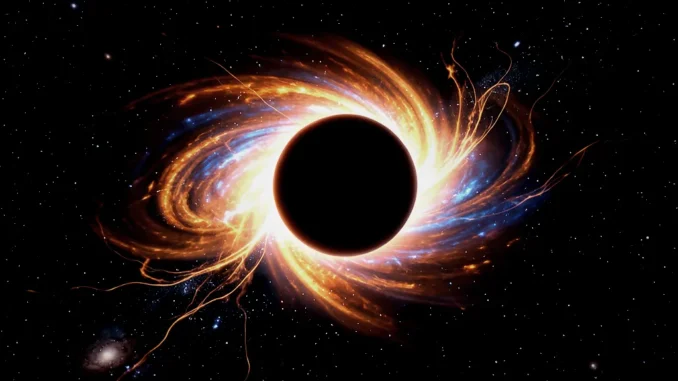
In a groundbreaking discovery, NASA’s Neil Gehrels Swift Observatory has observed a remarkable cosmic event: a star torn apart by a supermassive black hole located over 30,000 light-years away from the core of its galaxy. This unprecedented finding challenges longstanding theories about the positioning and behavior of such colossal objects in galactic structures.
Typically, supermassive black holes are found at the centers of galaxies, where their gravitational pull dominates. However, the recent detection reveals a rare phenomenon: a stellar disruption occurring far outside the galactic nucleus, suggesting the existence of a rogue or wandering black hole roaming in the galaxy’s outskirts.
How Did This Stellar Catastrophe Occur So Far From the Galactic Core?
Scientists recognize that such stellar disruptions generally happen when a star ventures too close to a supermassive black hole and gets shredded by its intense gravity. What makes this case extraordinary is the location — approximately 30,000 light-years away from the galaxy’s center. This raises vital questions: Did the black hole migrate away from the core? Or, perhaps, did a smaller galaxy with its own black hole get absorbed into the larger galaxy, and now it’s wandering in the outskirts?
Decoding the Phenomenon: The Role of Tidal Disruption Events (TDEs)
When a star approaches a supermassive black hole closely enough, the tidal forces can rip it apart — creating a dramatic flare of light known as a tidal disruption event (TDE). These events are invaluable cosmic laboratories for understanding black hole properties, accretion processes, and galaxy evolution.
In this recent case, the Swift Observatory detected an intense UV and X-ray emission indicator of a TDE. The brightness soared, briefly surpassing the luminosity of all stars in the galaxy combined, before gradually fading. Such a signature confirms a star was disrupted by an enormous gravitational powerhouse.
The Significance of a Distant Black Hole Disruption
Until now, confirmed TDEs have predominantly occurred near galactic centers, aligning with the common understanding that such massive objects reside in these regions. The detection 30,000 light-years away suggests two compelling possibilities:
- Existence of a wandering or ejected black hole — a remnant from a galaxy merger or a dynamically kicked black hole, migrating through the galactic halo.
- Presence of a smaller satellite galaxy with its own black hole, which was captured or stripped from its original host and now orbits in the outskirts.
This discovery significantly extends the potential regions where such stellar disruptions can occur, highlighting the need for broader, more vigilant searches across entire galactic volumes.
How Does This Change Our Understanding of Galactic Evolution?
Historically, astronomers have focused on galaxy centers when hunting for supermassive black holes. The rarity of observing such events away from the core has kept the narrative somewhat confined. Now, with this detection, models must incorporate the possibility of off-center black holes that can independently interact with stars, potentially leading to repeated TDEs in the galaxy’s halo.
This also impacts theories about galactic mergers and black hole dynamics. If black holes can be displaced or ejected, what does this imply about their growth, the gravitational wave signals we might detect, and the distribution of matter in a galaxy?
What Are the Next Steps for Astronomers?
The discovery opens an exciting frontier: systematically searching for similar off-center TDEs using wide-field surveys and targeted follow-ups. Instruments like the upcoming Vera C. Rubin Observatory will provide real-time alerts of transient phenomena, enabling astronomers to catch such rare events across the universe.
Simultaneously, researchers will analyze existing data to identify past candidate events and develop simulations to understand the formation and behavior of wandering black holes. Confirming multiple cases will help refine models of how black holes evolve within complex galactic environments, especially post-merger or post-ejection scenarios.
The Broader Implications: Connecting the Dots in Cosmic Evolution
This discovery underscores that supermassive black holes are not static fixtures confined to galaxy centers. Instead, they can roam, interact, and influence their surroundings far from the galactic core, reshaping our comprehension of cosmic structure formation. Understanding these wandering giants could unlock answers about the frequency of galaxy mergers, the growth of black holes, and the distribution of dark matter supporting such dynamics.
In essence, observing a star torn apart by a rogue black hole 30,000 light-years away from its galactic nucleus compels astronomers to rethink the lifecycle and distribution of these enigmatic entities. It pushes the boundaries of current models, inviting new theories and observations to depict a more nuanced picture of the universe’s most mysterious objects.