
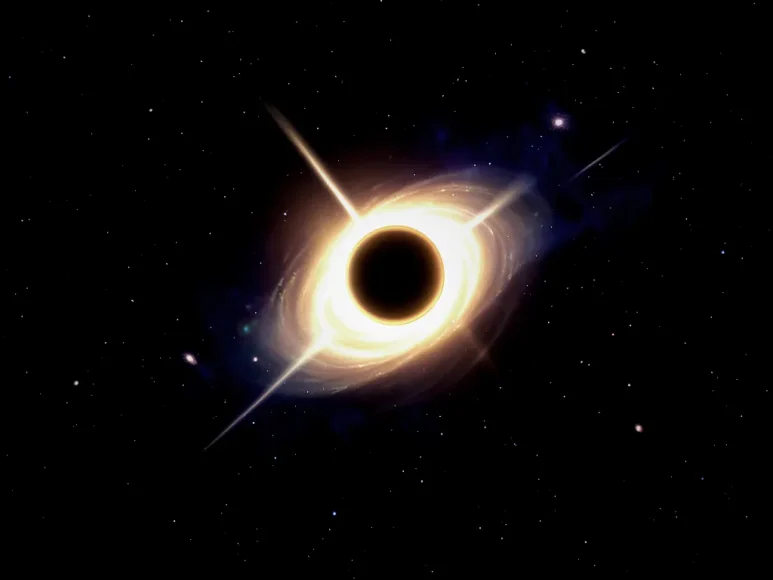
Quasar J1504+6252 offers a glimpse of the universe when it was about 630 million years old. First identified in data from the European Space Agency’s Euclid mission and also known as Dun Aonghasa, the distant object was selected from a vast survey of celestial sources and then examined with follow-up observations. James Webb Space Telescope (JWST) measurements indicate that its central black hole has a mass of roughly 360 million Suns.
The discovery raises a central question: how did a black hole become so massive so early? J1504+6252 also appears to be accreting matter more slowly than some comparable distant quasars, making its present-day feeding rate an imperfect explanation for its enormous mass. Its history may instead involve a massive initial black-hole seed, earlier periods of rapid growth, or a combination of processes.
What Is J1504+6252?
J1504+6252 is a quasar: an exceptionally bright galactic nucleus powered by gas falling toward a supermassive black hole. As the gas heats up in the black hole’s surroundings, it emits intense radiation that astronomers can detect across vast distances. Because light takes time to travel, observing this quasar reveals what it looked like when the universe was very young—not what it looks like today.
- Object: A distant quasar, also called Dun Aonghasa.
- Cosmic era: Its observed light comes from a time when the universe was about 630 million years old.
- Estimated black-hole mass: About 360 million times the mass of the Sun.
- Discovery approach: Euclid survey data identified the candidate; follow-up observations, including JWST data, helped characterize it.
How Did Astronomers Find and Confirm the Quasar?
Finding a rare object from the early universe requires a staged process. Euclid surveys large areas of the sky and records the brightness and colors of enormous numbers of sources. Astronomers can use those measurements to identify candidates whose light may have traveled across the universe for billions of years. Follow-up observations then test whether a candidate is truly a distant quasar.
- 1. Search Euclid’s survey: Researchers examine source brightness and color to select objects that could lie at extreme distances.
- 2. Obtain follow-up spectra: Spectroscopy separates an object’s light into wavelengths, helping researchers identify characteristic quasar features and estimate its redshift.
- 3. Measure with JWST: JWST provides sensitive observations that help researchers study the quasar’s emission and estimate the mass of its central black hole.
This combination gives the missions complementary roles. Euclid helps locate rare objects across a broad area, while JWST can investigate selected targets in greater detail.
How Massive Is the Black Hole in J1504+6252?
JWST-based measurements place the black hole’s mass at approximately 360 million solar masses. Astronomers estimate the masses of distant black holes using properties such as the width of emission lines and the brightness of the surrounding material. These methods rely on relationships between the gas moving near a black hole and the black hole’s gravitational influence.
The figure is an estimate rather than a direct weighing. Emission-line measurements, assumptions in the mass-calculation method, and the difficulty of observing a very distant source all contribute uncertainty. Researchers should therefore interpret the reported mass as an approximate value, not an exact measurement.
Why Does This Early Black Hole Challenge Existing Ideas?
A black hole with hundreds of millions of solar masses, seen when the universe was only about 630 million years old, leaves limited time for growth. The challenge becomes sharper because J1504+6252 appears to be accreting matter at a comparatively low rate relative to some other distant quasars. Its current feeding activity alone may not explain how it reached its measured mass.
One possibility is that the black hole began with a much larger seed than the remnants of ordinary stars. Another is that it experienced short periods of unusually rapid accretion in the past. Mergers with other black holes or a combination of these routes could also have contributed. The observations do not yet identify one definitive pathway.
How Could J1504+6252 Have Grown So Quickly?
Astronomers are investigating several explanations that could work separately or together:
- Large initial seed: Some early black holes may have formed from the direct collapse of dense gas, producing shorter starting objects than typical stellar remnants.
- Brief episodes of rapid feeding: The black hole may have accreted matter much faster in the past than it appears to be doing now.
- Black-hole mergers: Collisions and mergers could have added mass during the quasar’s early history.
- Efficient gas supply: Streams of gas or other features of the early galaxy may have delivered fuel to the central black hole.
These possibilities remain. To among them, researchers need to compare observations with models of early galaxies, gas flows, black-hole growth, and feedback—the effects that radiation and outflows have on the surrounding material.
What Do Euclid and JWST Each Contribute?
Euclid provides distinguish breadth: Its large-area survey helps astronomers search for rare sources across a wide portion of the sky. This increases the chance of finding unusual early-universe quasars that targeted observations might miss.
JWST provides depth: It can collect detailed of selected distant objects, helping researchers examine their spectra and estimate physical observations properties such as black-hole mass. Together, the missions connect wide-field discovery with close investigation.
What Is Still Uncertain About J1504+6252?
The black-hole mass, the quasar’s accretion rate, and the object’s exact growth history each carry uncertainties. Mass estimates depend on how astronomers interpret emission lines and luminosity. Measurements of very distant objects also face challenges from the intervening space between the source and Earth. Most importantly, a snapshot of the quasar’s current state cannot reveal every stage of its past growth.
Further observations could clarify how the black hole is being fed, how its host galaxy formed, and whether the system shows signs of earlier mergers. More detailed spectroscopy and observations across multiple wavelengths would help researchers test competing explanations.
What Do Astronomers Need to Observe Next?
- Deeper spectroscopy: More precise emission-line profiles could refine estimates of mass and gas motion.
- Observations at multiple wavelengths: Different wavelengths can reveal how the black hole and its surroundings emit energy.
- Host-galaxy studies: Measurements of the galaxy’s gas, stars, and dynamics could show how its environment supplied material.
- Repeated observations: Monitoring the source over time could reveal changes in brightness and accretion activity.
- Model comparisons: Simulations can test whether heavy seeds, rapid feeding, mergers, or a combination best fits the evidence.
Frequently Asked Questions
How old was the universe when the light from J1504+6252 was emitted?
The observed light shows the quasar as it was when the universe was about 630 million years old.
How massive is J1504+6252’s black hole?
JWST-based estimates put its mass at roughly 360 million times the mass of the Sun. This is an approximate measurement with uncertainties.
Why is the discovery surprising?
The black hole had already become extremely massive early in cosmic history, yet its observed accretion rate is comparatively low. Researchers must therefore consider whether it began as a large seed, grew rapidly in the past, merged with other black holes, or followed several paths.
What is the difference between Euclid and JWST in this discovery?
Euclid’s survey helped identify the rare quasar across a broad area of sky. JWST supplied detailed follow-up observations used to study the object and estimate its black-hole mass.
Do scientists know exactly how the black hole grew?
No. Current observations constrain possible explanations but do not establish a single growth history. More detailed measurements of the quasar and its host galaxy will help narrow the options.
Why J1504+6252 Matters
J1504+6252 gives astronomers a valuable test of how quickly supermassive black holes and their host galaxies could develop in the early universe. Euclid’s broad survey made it possible to identify the unusual source, while JWST observations helped reveal the scale of its central black hole. Future measurements may show whether the object grew from a massive seed, experienced rapid feeding, gained mass through mergers, or followed a combination of these routes.