
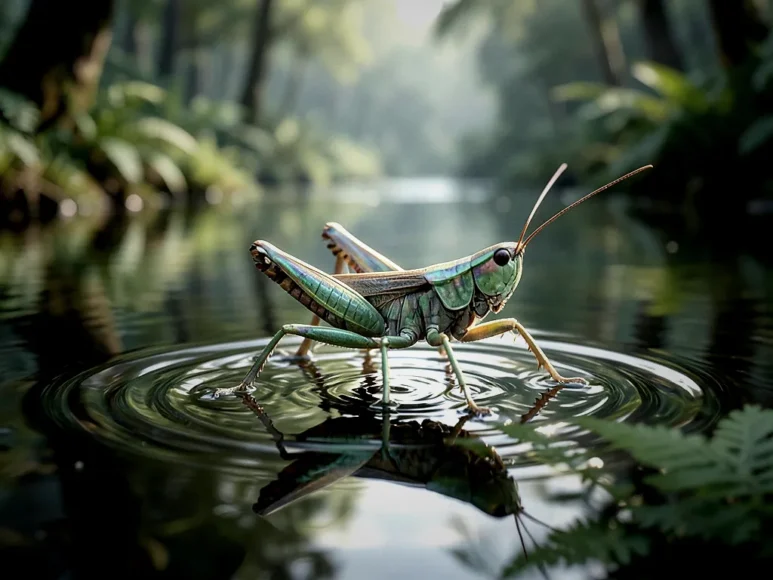
Nine tiny insects preserved together in 99-million-year-old amber offer a rare glimpse of life beside Cretaceous waterways. Researchers identified them as Hydrelcana zhangi and proposed a new insect family, Hydrelcanidae. Their long, slender legs, water-repelling hairs and unusual leaf-shaped structures on the hind legs suggest that these insects could move across the water’s surface.
What is Hydrelcanidae?
Hydrelcanidae is a proposed family of extinct, wingless insects described from Cretaceous amber. The researchers assigned the specimens to the species Hydrelcana zhangi. The insects had short bodies and long legs, giving them a grasshopper-like appearance, but their limb structures point to a possible adaptation for life on or near water.
The fossils date to approximately 99 million years ago. Researchers described the findings in Proceedings of the Royal Society B: Biological Sciences, using the preserved body features to distinguish the insects from known groups.
How could these insects move across water?
The insects’ legs appear suited to exploiting water’s surface tension—the force that allows small objects and organisms to rest on the water’s surface without immediately sinking. Fine, water-repelling hairs could help distribute their weight and keep water from wetting the legs.
The most distinctive feature is a leaf-shaped expansion on the lower part of each hind leg. These structures may have provided a broader surface for pushing against the water. Together, the hairs and expanded leg sections suggest a combination of balance and propulsion rather than simple floating.
- Water-repelling hairs: May have helped keep the legs dry and spread pressure across the surface.
- Long, slender legs: Could have helped distribute the insect’s weight across several points of contact.
- Leaf-shaped hind-leg structures: May have increased the area available for pushing against the water.
These interpretations are based on preserved anatomy. The fossils do not show the insects moving, so researchers cannot confirm exactly how they walked or whether they used the water surface continuously.
Why were nine individuals preserved together?
Nine insects appear in the same amber specimen. Their shared preservation raises the possibility that they were gathered in one place before resin trapping them. They may have been feeding near one another or responding to the same local conditions.
The group does not, by itself, prove that the insects lived in organized colonies or regularly cooperated. A resin flow could have trapped several individuals at once, preserving a moment of proximity without revealing how often they gathered. Even so, the specimen provides valuable evidence that multiple members of the species occupied the same setting.
What did Hydrelcana zhangi eat?
The available evidence does not establish a specific diet. The insects may have fed on plants or organic material near the water, but that remains an interpretation rather than a confirmed finding. Their body shape and the fact that several individuals were preserved together do not provide enough information to determine precisely what they ate.
Without direct evidence such as preserved food in the gut or clear feeding damage on plants, the safest conclusion is that their diet remains uncertain.
How does Hydrelcanidae compare with modern water-walking insects?
Modern water striders, including insects in the family Gerridae, use long legs and water-repelling hairs to move across the surface. Hydrelcanidae may have relied on some of the same physical principles, but its leaf-shaped hind-leg structures set it apart from the familiar water-strider body plan.
The fossils suggest a possible alternative design for moving across water. The expanded hind legs may have helped the insects push against the surface, although researchers cannot yet determine how their movement compared with that of modern water striders.
- Shared possible adaptation: Both groups have features associated with surface movement, including long legs and water-repelling hairs.
- Notable difference: Hydrelcanidae had leaf-shaped expansions on the hind legs.
- Important limitation: Similar features do not prove that the extinct insects moved exactly like modern water striders.
Why is the amber fossil important?
Amber can preserve small structures that ordinary fossilization often obscures, including fine hairs and delicate limb shapes. In this case, the resin preserved several individuals together, allowing researchers to examine both their anatomy and the context in which they were trapped.
That combination helps scientists investigate more than the insects’ appearance. It also supports questions about their possible habitat and whether they gathered near one another. The fossils add a potential example of water-surface adaptation to the record of Cretaceous insects.
What the discovery does—and does not—show
The fossils support the identification of a distinctive insect form and suggest that its legs may have helped it use the water’s surface. They also show that nine individuals became trapped in the same piece of amber.
However, the specimen cannot confirm the insects’ exact behavior, diet or social structure. Those questions require evidence that the preserved anatomy and amber context alone cannot provide.
Frequently asked questions
How old is Hydrelcanidae? The amber specimens are about 99 million years old and date to the Cretaceous Period.
What species did researchers identify? They named the species Hydrelcana zhangi and proposed Hydrelcanidae as a new family.
Could Hydrelcana walk on water? Its leg hairs and leaf-shaped hind-leg structures suggest that it may have moved across the water’s surface. The fossils preserve anatomy, not movement, so this remains a scientific interpretation.
Does finding nine insects together prove they lived socially? No. Their shared preservation shows that they were trapped together, but it cannot establish whether they regularly formed groups.