
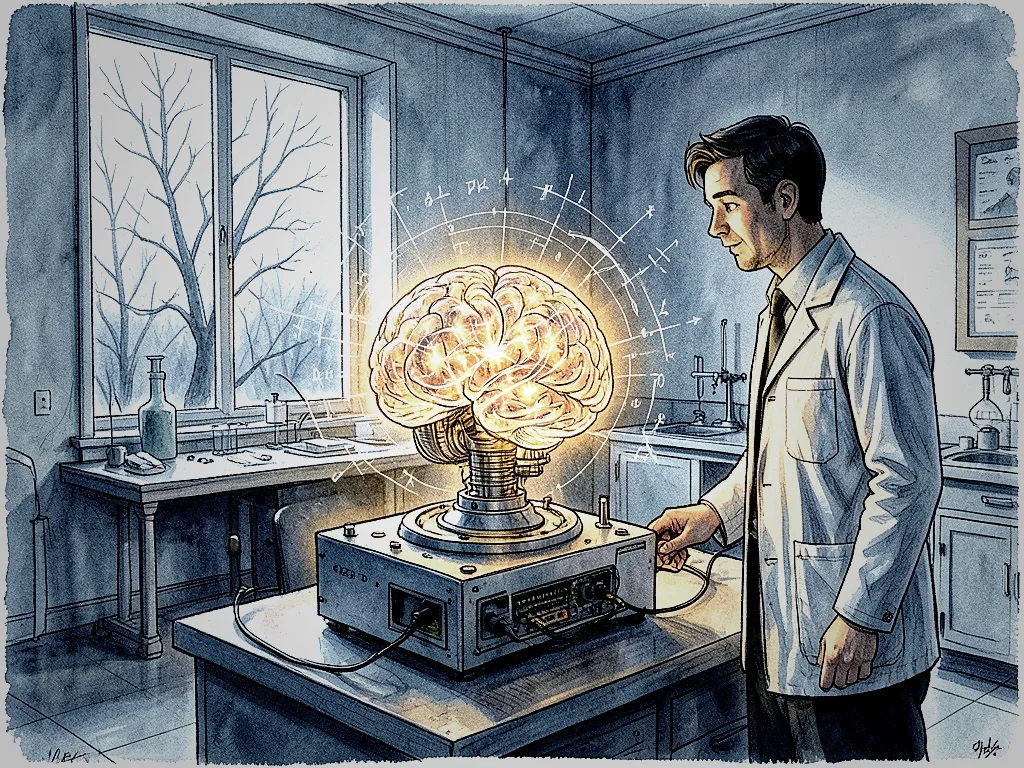
A report dated November 2026 claims that Levent Alpöge and a Claude team proved the Riemann Hypothesis using artificial intelligence and a large body of computer-checked work. The claim describes a proof built from millions of lines of code, verified with specialized software. Such a result would be extraordinary: the Riemann Hypothesis has remained one of mathematics’ best-known unsolved problems since Bernhard Riemann introduced it in 1859.
Important context: The supplied report does not identify a publication, independent verification, or a public proof archive. Its claims should therefore be treated as unverified, rather than as an established mathematical result. A major proof would require scrutiny by experts and reproducible access to the definitions, code, and verification tools.
What is the Riemann Hypothesis?
The Riemann Hypothesis concerns the zeros of the Riemann zeta function, a mathematical object closely connected to the distribution of prime numbers. It predicts that every nontrivial zero lies on a particular vertical line in the complex plane, where the real part equals one-half.
If true, the hypothesis would sharpen estimates of how primes are distributed. It would not provide a simple formula listing every prime, nor would it immediately change everyday technology. Its importance comes from the way it links a precise statement about the zeta function to the irregular pattern of prime numbers.
How would a computer-checked proof work?
A computer-assisted proof can combine mathematical reasoning with formal logic and computation. In a formal proof, researchers encode definitions and claims in a system that checks whether each inference follows from previously established rules. Large computations can then handle steps that would be impractical to verify by hand.
- Formalize the mathematics: Translate definitions, assumptions, and lemmas into a language a proof assistant can check.
- Generate the proof: Researchers or software construct the argument, including any extensive calculations.
- Check the result: A proof assistant verifies that each formal step follows from the system’s rules.
- Enable independent review: Other researchers examine the mathematical setup, software, and proof files, and attempt to reproduce the checks.
A large codebase does not by itself establish a theorem. Reviewers need to know what the code proves, whether the formalization accurately represents the intended mathematics, and whether the checking system has been implemented correctly. A readable mathematical explanation also helps experts understand the key ideas behind the formal result.
Would a proof immediately break internet encryption?
No. The Riemann Hypothesis does not directly reveal private keys or provide a method for factoring the large numbers used by common public-key cryptography. A proof could influence number theory and inspire new research, but that is different from demonstrating a practical attack on banking, messaging, or web security.
Cryptographic systems face separate risks, including advances in computing and the development of quantum computers. Organizations already assess and adopt post-quantum cryptographic standards to prepare for those risks. Any change prompted specifically by a proof of the Riemann Hypothesis would depend on later discoveries, not follow automatically from the proof itself.
What could the hypothesis affect if proven?
A proof would confirm a central prediction about prime-number distribution and could strengthen results across analytic number theory. Researchers might use the new methods, or consequences of the theorem, to improve estimates in related problems. The report also suggests possible connections to algorithms, numerical analysis, and random-number generation, but those applications would need to be demonstrated separately.
For example, better theoretical bounds can help researchers understand how much error to expect in a calculation involving primes. That insight may be useful in mathematical research or specialized computing. It does not automatically make simulations more accurate or improve every random-number generator.
What does the report say about the Navier–Stokes equations?
The report also refers to alleged November findings about the Navier–Stokes equations, which describe fluid motion. It says certain conditions may lead to solutions that start uncontrolled. The supplied material gives no paper, technical details, or independent confirmation, so this should also be treated as an unverified claim.
Results about the limits of a mathematical model can matter to fluid dynamics, but they do not directly establish that weather forecasts or aircraft designs will fail. Practical forecasting and engineering rely on numerical methods, measured data, and model assumptions; researchers would need to explain precisely how any new theorem changes those tools.
How to assess a claim of a major mathematical breakthrough
- Find the primary source: Look for a complete paper, named authors, and a clear account of the theorem.
- Check the proof materials: For a computer-verified result, look for accessible formal files, software, and instructions to reproduce the checks.
- Look for independent review: Seek assessments from who are not part of the original team. their discoveries?
Be the first to comment