
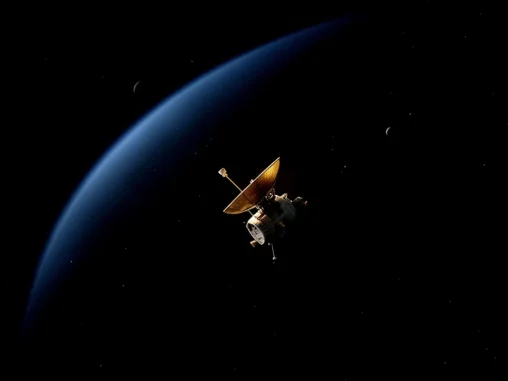
NASA announced that Voyager 1 reached a distance of one light-day from Earth at 05:16 Eastern Time on November 18, 2026. A light-day is the distance light travels in 24 hours—about 25.9 billion kilometers. Because radio signals travel at approximately the speed of light, a message from Voyager 1 takes roughly 24 hours to reach Earth. A command sent from Earth and its reply therefore require about 48 hours for the round trip.
What does one light-day from Earth mean?
One light-day describes distance, not the spacecraft’s travel time. Voyager 1 is about 25.9 billion kilometers away, so a signal sent from the spacecraft takes approximately 24 hours to reach Earth. The same delay applies to a command traveling from Earth to the probe.
For example, if engineers send a command on Monday, Voyager 1 cannot receive it until roughly Tuesday. Its response then takes another day to return. This delay means mission teams must plan carefully rather than control the spacecraft in real time.
When will Earth receive Voyager 1’s signal?
NASA expected the first signal associated with the milestone to reach the Jet Propulsion Laboratory on November 19, the day after Voyager 1 reached the one-light-day distance. The exact reception time depends on when the spacecraft transmits and when the Deep Space Network antennas can track it.
Voyager 1 communicates with Earth through NASA’s Deep Space Network. The network’s large antennas collect extremely faint radio signals and pass the data to mission teams for processing and analysis.
Voyager 1’s journey from launch to interstellar space
NASA launched Voyager 1 on September 5, 1977, to study the outer planets. The spacecraft flew past Jupiter in 1979 and Saturn in 1980, returning detailed images and scientific measurements. It later continued beyond the planets and crossed the heliosphere’s outer boundary in August 2012, entering interstellar space.
Voyager 1 has remained the most distant human-made object from Earth since 1998. Its continuing measurements offer a rare opportunity to study the environment beyond the Sun’s protective bubble, including magnetic fields, plasma, and cosmic rays.
How engineers receive and verify Voyager 1 data
Because the signal is weak and takes a day to travel each way, mission teams follow a deliberate process:
- Track the spacecraft: Deep Space Network antennas point toward Voyager 1 during a scheduled communication window.
- Capture the signal: Antennas collect the radio transmission and forward it for processing.
- Decode the data: Engineers filter noise, reconstruct the transmitted information, and apply error-correction techniques.
- Check spacecraft health: Teams review telemetry about power, temperature, communications, and operating instruments.
- Plan and confirm commands: Engineers send any necessary instructions, then wait for Voyager 1’s reply to verify the result.
The long communication delay makes autonomous operation essential. Voyager 1 must carry out instructions without immediate guidance from Earth.
What Voyager 1 measures in interstellar space
Voyager 1’s instruments provide direct measurements of the region beyond the heliosphere. Its data help researchers examine plasma density, magnetic-field conditions, and cosmic-ray levels. These observations offer clues about how the solar boundary interacts with the surrounding interstellar environment.
Changes in plasma measurements recorded after the spacecraft entered interstellar space have helped scientists investigate conditions near the heliosphere’s outer edge. Because few spacecraft have traveled this far, even limited new measurements can add valuable context to models of the space between stars.
How Voyager 1 manages its remaining power
Voyager 1 receives electricity from radioisotope thermoelectric generators. These power sources gradually produce less electricity, so engineers must balance the need to maintain communications with the value of keeping scientific instruments operating.
To conserve power, the team can turn off or reduce the use of selected instruments, optimize data-collection periods, and adjust communication schedules. The spacecraft’s future operating lifetime depends partly on how much power remains and which systems engineers can continue to support.
How long does a message take to reach Voyager 1?
A radio message takes about 24 hours to travel from Earth to Voyager 1 at a distance of one light-day. A reply takes about another 24 hours to return, so a complete command-and-response exchange takes roughly 48 hours, not including scheduling or processing time.
Why is Voyager 1 still scientifically useful?
Voyager 1 is valuable because it sends measurements from beyond the heliosphere—an environment that spacecraft near Earth cannot sample directly. Its observations help researchers study the boundary between the Sun’s influence and interstellar space, as well as the particles and magnetic fields found there.
The spacecraft’s declining power limits how many instruments can remain active, but carefully chosen measurements can continue to provide information unavailable from any closer mission.








Be the first to comment