
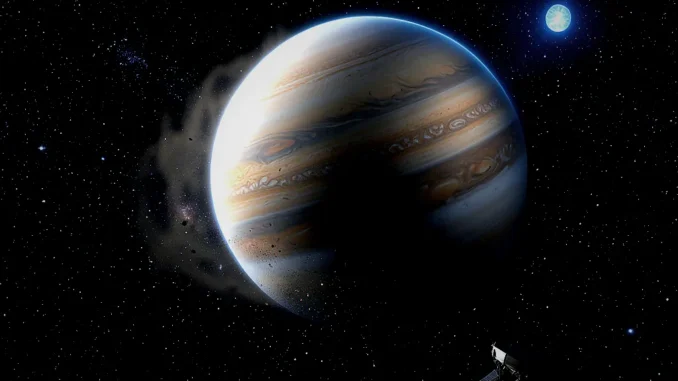
TOI-2535b did not disappear from its star system. Instead, its transit—the brief dimming that occurs when a planet crosses in front of its star from Earth’s viewpoint—became too shallow to detect and then stopped. Researchers attribute this change to gravitational interactions with a second giant planet, which gradually alter the planets’ orbital orientations.
Observations spanning several years reportedly tracked the transit as it weakened and vanished. The proposed explanation is a long-term cycle of orbital precession: the planets’ orbits tilt and shift over time, changing whether TOI-2535b crosses the star’s visible disk from our line of sight.
Why did TOI-2535b’s transit disappear?
TOI-2535b’s transit disappeared because its orbit changed orientation relative to Earth. A planet can continue orbiting its star while becoming temporarily invisible in transit if it no longer passes across the star’s disk from our perspective.
In this system, the likely driver is the gravitational pull of a second giant planet. The two planets tug on each other, gradually changing the direction and inclination of their orbital planes. As the transit path moves toward the edge of the star and then beyond it, the observed transit becomes increasingly shallow before vanishing.
How can a planet’s orbit make its transit fade?
A transit depends on alignment. The planet must pass between its star and Earth, crossing the star’s apparent disk. Even a small change in orbital inclination can alter this alignment, especially when the planet already passes close to the star’s edge as seen from Earth.
- At first, the planet crosses well inside the star’s apparent edge, producing a clear dip in brightness.
- As the orbit shifts, the planet’s path moves closer to the edge, so the transit becomes shorter or shallower.
- Once the path moves outside the star’s disk, the planet still orbits, but observers on Earth no longer see a transit.
This distinction matters: a missing transit does not, by itself, mean that a planet has been destroyed, ejected, or stopped orbiting.
What role does the second planet play?
The second planet can alter TOI-2535b’s orbit through repeated gravitational interactions. Over many orbits, those interactions may turn the orbital plane, a process known as nodal precession. If the two orbits are tilted relative to each other, their mutual influence can also produce changes in their relative inclinations.
Researchers can test this explanation by combining transit observations with measurements of the star’s motion. A planet’s gravity makes its star move slightly, creating a measurable signal in the star’s spectrum. Astronomers can then compare those measurements with numerical simulations of the two-planet system to see whether the proposed configuration reproduces the observed changes.
What observations support the orbital-change explanation?
The reported case draws on a multi-year observing campaign. The central evidence is the changing transit signal: early observations showed transits, while later measurements indicated that the events became weaker and eventually could no longer be seen. Measurements of the star’s motion and orbital simulations provide additional ways to assess whether a companion planet could cause the changing alignment.
- Photometry records changes in the star’s brightness and reveals whether a planet crosses its disk.
- Transit timing and shape help track changes in the duration, depth, and timing of each event.
- Radial-velocity measurements track the star’s motion toward and away from Earth, which can reveal the gravitational influence of orbiting planets.
- N-body simulations model how multiple planets move under their mutual gravitational pulls.
How long could it take for TOI-2535b to transit again?
The timing depends on the system’s orbital geometry and the strength of the planets’ interaction. The proposed models indicate that the alignment may change over decades, with a possible cycle on the order of 30 to 50 years. That range is a model-based estimate, not a guaranteed schedule; continued observations are needed to refine it.
If the orbit swings back into an alignment that lets the planet cross the star’s disk, astronomers may detect transits again. Regular monitoring can help narrow down when that might happen and test whether the predicted orbital cycle matches reality.
What is known about the TOI-2535 system?
The available description identifies TOI-2535b as a Jupiter-like gas giant orbiting a K-type dwarf star. It also describes a second giant planet whose gravitational effect could explain the changing transit geometry. The companion’s detailed properties are harder to establish from transit data alone, particularly if it does not cross the star from Earth’s viewpoint.
Radial-velocity observations and dynamical modeling can help constrain the companion’s mass and orbit. Those estimates depend on the quality and duration of the data, so they should be treated as constraints rather than direct measurements unless independently confirmed.
Could astronomers study TOI-2535b’s atmosphere?
Atmospheric studies become easier when a planet transits its star. During a transit, some starlight passes through the planet’s atmosphere, and instruments can search for wavelength-dependent changes that reveal atmospheric gases and aerosols.
If TOI-2535b transits again, astronomers could attempt transit spectroscopy, subject to the planet’s brightness, the star’s properties, and the capabilities of available instruments. While the transit remains absent, other techniques may still offer information, but they generally cannot use the same transmission-spectroscopy method.
What can future observations reveal?
Continued observations can test whether the transit loss results from orbital precession and improve estimates of the companion planet’s influence. The most useful next steps include:
- Repeated photometry to search for any renewed transit signal and measure changes in its depth or duration.
- Long-term radial-velocity monitoring to better constrain the second planet’s mass and orbit.
- Updated dynamical simulations to compare predicted alignment changes with new measurements.
- Atmospheric observations, if transits return, to investigate the planet’s atmosphere.
Frequently asked questions about TOI-2535b
Has TOI-2535b stopped orbiting its star?
No. A transit can disappear because the planet’s orbit no longer lines up with Earth. The planet may continue orbiting even when observers cannot see it cross the star.
Why did the transit become shallower?
The planet’s path appears to have moved closer to the edge of the star’s disk. A grazing transit blocks less starlight, so its signal becomes weaker.
What could make the orbit change?
Gravitational interactions with a second planet can gradually change the orientation of TOI-2535b’s orbit.
When might the transit return?
Models suggest the alignment could vary over decades, with an estimated cycle of roughly 30 to 50 years. More observations are needed to determine the timing.
Can astronomers observe the planet while it does not transit?
They can search for other signals, such as the star’s motion caused by the planet’s gravity. However, methods that rely on starlight passing through the planet’s atmosphere require a transit.








Be the first to comment