
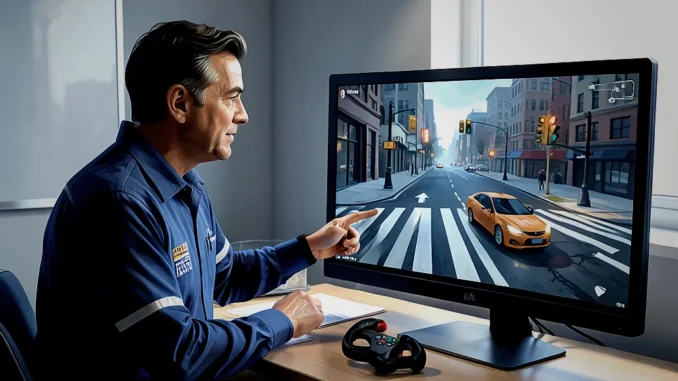
Researchers use Grand Theft Auto (GTA) games as flexible virtual environments for studying traffic behavior, bicycle safety, and autonomous driving. By controlling traffic density, weather, road layouts, and dangerous events, they can repeat experiments without exposing participants to real-world hazards. GTA simulations can support early-stage research, but their results require validation with real vehicles, sensors, and road users.
Why do researchers use GTA for traffic research?
GTA offers detailed urban environments, moving vehicles, variable weather, and complex traffic situations. Researchers can modify or control parts of the game to create repeatable scenarios, such as a car passing close to a cyclist or a pedestrian entering the road unexpectedly.
Compared with on-road experiments, virtual testing is often less costly and makes it easier to reproduce the same event. It also allows researchers to examine situations that would be dangerous or difficult to stage in real traffic. However, a game remains a simulation: its driving physics, traffic behavior, and sensor data do not perfectly match real-world conditions.
How do researchers test bicycle-safety devices in GTA?
A research team at Osnabrück University of Applied Sciences used a virtual cycling setup to study devices that warn cyclists about approaching vehicles. The prototypes included handlebar-mounted vibration alerts and a wearable vest that signaled danger through vibration.
The test process followed several steps:
- Set up the simulation: Researchers placed a real bicycle in front of screens showing the virtual road and rear-view scene.
- Create challenging traffic: Participants rode through scenarios featuring fast-moving trucks, narrow lanes, and sudden overtaking.
- Deliver warnings: The devices detected approaching vehicles and used vibration to alert the rider.
- Record responses: Researchers measured reaction times, eye movements, and participants’ choices on the road.
The tests suggested that vibration alerts could help riders notice approaching hazards. Further work is needed to refine comfort and usability and to evaluate the devices in longer-term real-world trials.
What can virtual traffic experiments reveal about human behavior?
Researchers can use simulations to study how people respond to hazards and how road design affects those responses. For example, they can compare cyclist behavior on different lane layouts or examine whether a change to an intersection encourages safer decisions.
These experiments help separate the effects of specific design features because researchers can alter one condition while keeping others consistent. Simulations do not capture every distraction or unexpected event found on real roads, so findings should guide—not replace—field research.
How is GTA data used to train autonomous-driving systems?
Researchers can generate or collect simulated driving scenes to expose autonomous-driving systems to varied traffic conditions. A typical workflow includes:
- Generate scenarios: Create situations involving congestion, sudden vehicle movements, pedestrians, or poor weather.
- Label important details: Identify road users, possible collision points, vehicle speeds, and environmental conditions.
- Train models: Use the labeled examples to develop systems for perception, prediction, and route planning.
- Evaluate performance: Test whether the system detects hazards, avoids collisions, and responds consistently in both familiar and new scenarios.
Simulated data can provide many varied examples, but a model trained on game imagery may struggle with real cameras and sensors. Differences in lighting, object appearance, road markings, and sensor noise can reduce performance outside the simulation.
Can GTA simulations test ethical decisions by autonomous cars?
Researchers can construct virtual scenarios in which an autonomous vehicle must respond to a dangerous situation. For instance, a system might face a choice between braking, swerving, or continuing along its current path when another road user enters its lane.
Researchers can compare how different decision rules affect outcomes, then assess the system’s response against human judgments. These tests can expose assumptions built into an algorithm, but they cannot settle which ethical rule society should adopt. Any reported safety benefit depends on the scenarios, assumptions, and evaluation method used; results from one simulation should not be treated as a universal outcome.
Can simulation results transfer to real roads?
Not automatically. Real-world traffic includes sensor errors, unusual road layouts, unpredictable human behavior, and environmental details that a game may not reproduce. Researchers use several methods to narrow this gap:
- Adapt models: Adjust systems trained on simulated data so they can handle real-world images and sensor measurements.
- Use staged testing: Move from simulation to controlled tests and then to carefully monitored road trials.
- Model real sensors: Add realistic camera, radar, or other sensor behavior to make virtual data more representative.
- Check varied conditions: Test the system across different weather, lighting, traffic, and road scenarios.
Simulation works best as one stage in a broader safety process, not as proof that a system is ready for public roads.
What legal and research-ethics issues apply?
Researchers must consider the game’s copyright and licensing terms, especially when modifying software, collecting data, or distributing game-derived material. Depending on the project, they may need permission from the rights holders or may choose an alternative research simulator with clearer licensing.
Studies involving human participants also require appropriate ethics review, informed consent, and measures to reduce discomfort or risk. Researchers should describe the limits of their methods and report results in a way that does not imply that simulated performance guarantees real-world safety.
What are the main limitations of GTA-based research?
- Simulation realism: Game traffic and vehicle physics may differ from real conditions.
- Data mismatch: Virtual images and sensor inputs may not match those produced by real equipment.
- Behavioral differences: Participants may behave differently in a game than they would while cycling or driving on actual roads.
- Licensing constraints: Commercial software can limit modification, data sharing, or publication.
- Need for validation: Researchers must confirm important findings through controlled real-world testing.
Could GTA VI support future traffic research?
A newer game could offer more detailed environments, physics, and non-player character behavior, potentially giving researchers additional scenarios to explore. Its usefulness would depend on access to the game’s tools and data, the realism of its simulation, and the permissions available for research use. More detail alone would not eliminate the need for real-world validation.
Frequently asked questions
Are GTA games realistic enough for traffic research? They can represent useful traffic situations and support controlled experiments, but they do not reproduce every feature of real roads, sensors, or human behavior.
Can an autonomous car trained on GTA data drive safely in real life? Simulated data can help train and test a system, but researchers must also evaluate it with real sensor data and carefully staged road tests.
Why use a game instead of testing on an actual road? A game makes it easier to repeat hazardous situations safely, change conditions systematically, and test early prototypes before moving to field trials.
Do researchers need permission to use GTA? Requirements depend on how the game is used, modified, and shared. Researchers should review the applicable licensing terms and seek permission when required.










Be the first to comment