
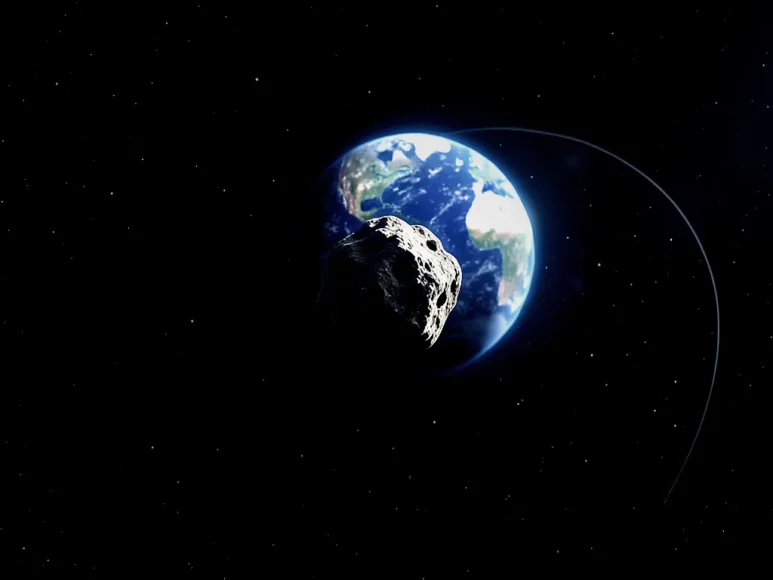
2026 QQ8 is described as a roughly two-metre-wide natural object temporarily caught near Earth. Observations from several telescopes helped astronomers track its position, measure changes in brightness and calculate its path. These measurements can help distinguish a natural asteroid from human-made space debris.
What is 2026 QQ8?
2026 QQ8 is reported to be a small natural object that entered a temporary orbit around Earth. Astronomers call such objects mini-moons or temporary satellites. Unlike the Moon, a mini-moon usually remains near Earth only briefly before escaping Earth’s gravitational influence and continuing around the Sun.
The object is estimated to be about two meters across. Its small size makes it difficult to observe, so researchers rely on repeated measurements rather than a single image to establish its motion and physical properties.
How was 2026 QQ8 detected?
The object was first observed in August by Krisztián Sárneczky at Hungary’s Konkoly Observatory, according to the information provided. Follow-up observations from facilities including the Lowell Discovery Telescope in Arizona and a University of Hawai’i telescope on Mauna Kea helped astronomers refine its track.
Researchers compare observations taken at different times to determine how an object moves against the background stars. This process, called astrometry, provides the positional data needed to calculate an orbit. Repeated brightness measurements, known as photometry, can also reveal how the object’s light changes as it rotates.
How can astronomers tell whether a mini-moon is natural or artificial?
Astronomers combine several kinds of evidence rather than relying on one clue. They examine the object’s orbit, brightness, color and response to forces such as sunlight. A natural asteroid and a piece of spacecraft debris can behave differently because they may have different shapes, materials, densities and ratios of mass to surface area.
- Orbit: Researchers check whether the measured path fits a natural object’s motion around Earth and the Sun.
- Brightness and colour: Photometry and, when available, spectroscopy can help assess surface reflectivity and material properties.
- Solar-radiation effects: Sunlight can Slightly alter an object’s motion. The size of that change can provide clues about its mass relative to its area.
- Combined evidence: Scientists compare all available measurements with the expected behavior of natural asteroids and artificial debris.
The supplied account says the observations were consistent with a natural object and did not show the typical signs expected of human-made debris. Such a conclusion depends on the quality and duration of the observations; measurements should be updated as additional data become available.
Could 2026 QQ8 hit Earth?
The supplied information describes the impact risk as negligible. At an estimated diameter of about two metres, an object entering Earth’s atmosphere would be expected to heat up and break apart. Most of its material would likely burn up or fragment before reaching the ground, although the exact outcome would depend on its composition, speed and structure.
A small object can still produce a bright meteor if it enters the atmosphere. That possibility is different from a serious ground-impact threat: the available account does not indicate that 2026 QQ8 poses a danger to people, homes or satellites.
Where do temporary mini-moons come from?
Temporary mini-moons are generally thought to come from populations of small Solar System bodies, including near-Earth asteroids. A passing object can become temporarily captured when gravitational interactions involving Earth, the Sun and sometimes the Moon change its path enough for it to spend time near Earth.
This capture is temporary. The object remains bound to Earth only while its orbit and the surrounding gravitational conditions allow it. Eventually, it can escape Earth’s influence and return to an orbit around the Sun.
When is 2026 QQ8 expected to leave Earth’s vicinity?
The supplied account says 2026 QQ8 is expected to leave Earth’s influence around the beginning of December and resume its orbit around the Sun. The exact timing depends on continued observations and orbit calculations, so the forecast may be refined as researchers collect more data.
What can astronomers learn from mini-moons?
Temporary satellites offer a chance to study small celestial objects that are otherwise difficult to observe. Tracking them helps scientists test models of orbital motion and understand how gravitational interactions capture and release small bodies.
Brightness changes and other observations can also provide clues about an object’s rotation, shape and surface reflectivity. These measurements contribute to broader studies of near-Earth objects and can help researchers improve observation and tracking methods.
How will new sky surveys help find more mini-moons?
Wide-field surveys that repeatedly image large areas of the sky can find faint objects that move between exposures. The Vera C. Rubin Observatory is designed to carry out extensive, repeated sky imaging, which is expected to increase detections of small Solar System bodies and improve the chances of spotting temporary captures.
Finding an object is only the first step. Astronomers need follow-up observations to confirm its motion, calculate its orbit and determine whether it is a temporary satellite, a near-Earth asteroid or another kind of object.
How does 2026 QQ8 compare with earlier mini-moons?
Two commonly cited examples of temporary mini-moons are 2006 RH120 and 2020 CD3. Like other temporary captures, these objects spent a limited period near Earth before leaving its vicinity. Their observations help scientists compare capture events and refine models of how small bodies move through the Earth–Sun system.
2026 QQ8 at a glance
- Object: 2026 QQ8
- Estimated diameter: About two metres
- First reported observation: August, by Krisztián Sárneczky at Konkoly Observatory
- Type: Reported natural temporary satellite of Earth
- Expected departure: Around early December, according to the supplied account
- Reported impact risk: Negligible
Note: This article reflects the details provided in the source material. Object designations, discovery records and orbital forecasts should be checked against current astronomical databases and official observatory updates.
Be the first to comment