
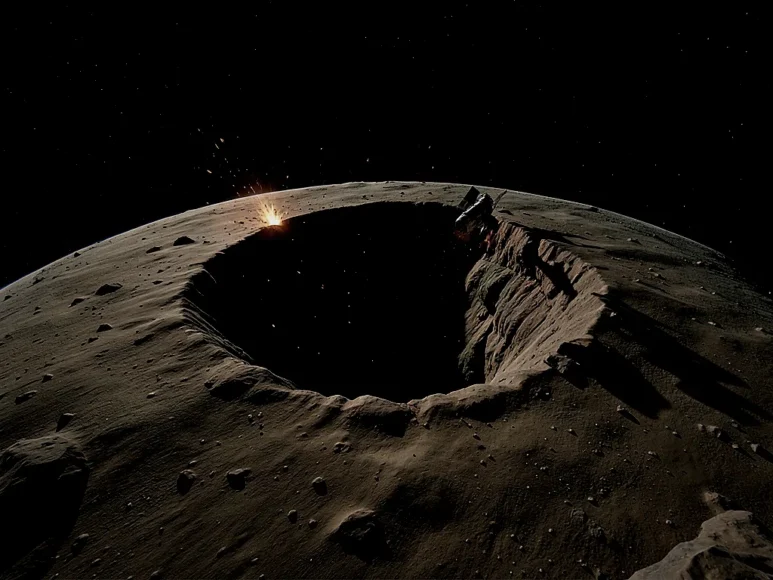
ESA’s Hera spacecraft has captured high-resolution images of Dimorphos, the small asteroid struck by NASA’s DART spacecraft in 2022. The images show a large impact crater, described as stadium-sized, along with meter-scale boulders and scattered surface debris. These observations help scientists investigate how the collision reshaped the asteroid and how future spacecraft might use kinetic impacts to alter an asteroid’s path.
What do Hera’s images reveal about Dimorphos?
The images show a prominent crater and a surface marked by rocks and impact debris. Some visible boulders measure roughly 3 to 10 meters across. Their distribution offers clues about how material moved during the collision and settled afterward.
Dimorphos is part of the Didymos binary asteroid system. DART deliberately struck Dimorphos to test whether a spacecraft could change an asteroid’s motion. Hera’s close-up observations are designed to examine the impact site and measure the resulting changes in detail.
How did the impact create the crater?
The collision released kinetic energy when DART hit Dimorphos. That energy excavated surface material, sent debris outward and altered the surrounding terrain. Some ejected material may have escaped the system, while other fragments could have fallen back onto Dimorphos or its larger companion, Didymos.
Scientists study the crater’s shape and debris pattern to understand how the asteroid’s material responded. Factors such as porosity, surface strength, impact speed and collision angle all influence how large a crater forms and how much material moves.
- Impact: DART transferred momentum to Dimorphos.
- Ejection: The collision launched rocks and finer particles from the surface.
- Redistribution: Some debris traveled away, while some material may have settled back onto the asteroid system.
- Measurement: Hera’s observations help researchers compare the actual results with impact models.
Did the collision change Dimorphos’s shape or rotation?
The impact may have changed Dimorphos’s shape, surface layout or rotational behavior by moving material and redistributing mass. Hera’s images provide information about the asteroid’s form and impact site, while measurements of the binary system can help scientists assess changes in its motion.
Researchers can compare observations taken at different times and use measurements of the system’s orbit and brightness to investigate how the collision affected the pair. These data help distinguish changes caused by the impact from the natural movement of the asteroids.
Why do the boulders behave differently in low gravity?
Gravity on a small asteroid is extremely weak compared with Earth’s. As a result, rocks and loose surface material can move differently after an impact. A fragment launched at modest speed may travel a considerable distance before falling back, and small forces can shift particles that would remain in place on Earth.
The boulders visible in Hera’s images can help scientists study the surface’s structure and how debris is settled. Their positions, sizes and surrounding terrain provide clues about the impact’s effects and the properties of Dimorphos’s surface.
How can Hera help improve asteroid-deflection plans?
Hera turns the DART experiment into a detailed investigation of an actual asteroid impact. By comparing the crater and surrounding debris with computer simulations, scientists can refine estimates of how much momentum a spacecraft transfers to an asteroid.
- Improve impact models: Match observed crater features and debris patterns against predictions.
- Assess the target: Use the asteroid’s shape and surface details to understand how its material responds.
- Evaluate the outcome: Combine close-up observations with orbital measurements to study the effect of the collision.
- Inform future missions: Apply the findings when selecting a spacecraft’s mass, speed and impact strategy.
How does Hera study the asteroid surface?
Hera uses images and other spacecraft observations to map the asteroids and examine the impact region. Scientists can combine images taken from different viewpoints to create three-dimensional models of the terrain. They can also study shadows and surface brightness to interpret features that are difficult to assess from a single image.
These measurements help researchers map the crater, describe the surrounding terrain and compare the observed surface with predictions from impact simulations.
How does NASA’s NEO Surveyor complement Hera?
Hera examines the Didymos system up close, while NASA’s planned NEO Surveyor mission is intended to search for near-Earth objects using infrared observations. Infrared measurements can help detect asteroids that are difficult to find through visible-light observations alone and estimate properties such as size.
The missions address different parts of planetary defense: surveys help find and characterize potential targets, while a close-up mission such as Hera investigates what happens when a spacecraft strikes an asteroid.
What will Hera investigate next?
Hera’s continued observations of Didymos and Dimorphos are expected to improve scientists’ understanding of the impact site, the asteroids’ shapes and the system’s physical properties. Detailed maps and measurements can help test models of crater formation and material movement.
- Impact-site mapping: Describe the crater and nearby terrain.
- Shape measurements: Build a clearer picture of each asteroid’s form.
- Surface analysis: Study boulders, debris and other visible features.
- Model testing: Compare observations with predictions of how an impact changes an asteroid.
Why are Hera’s Dimorphos important?
Hera’s observations offer a close look at the consequences of a deliberate asteroid impact. The crater, boulders and redistributed material provide evidence researchers can use to understand how Dimorphos responded to DART. That evidence will help improve impact simulations and guide the design of future asteroid-deflection missions.
Be the first to comment