
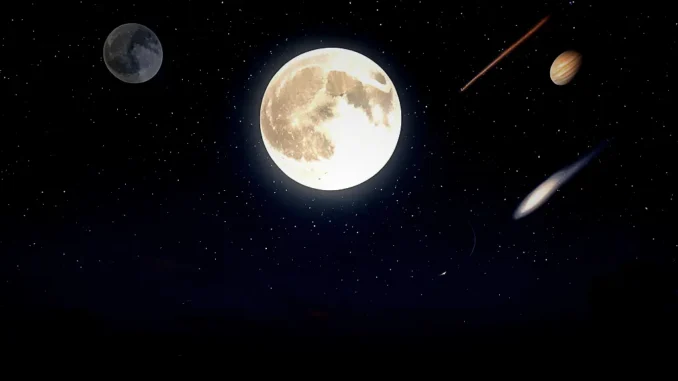
November offers several notable skywatching events, from bright Taurid fireballs and the Leonid meteor shower to a close-looking pairing of Mars and Jupiter. The month also brings a milestone for Voyager 1 and a full Moon described as a supermoon. For the best views, check local weather and moonrise and moonset times, choose a dark location, and give your eyes time to adjust.
Southern and Northern Taurid Meteor Showers
The Southern Taurids are expected to peak around November 5, followed by the Northern Taurids around November 12. Each shower typically produces about five meteors per hour under favorable conditions. The Taurids are known for occasional bright fireballs, so the display can be memorable even when meteor counts remain modest.
To watch the Taurids, find a dark site with a wide view of the sky and look up with your unaided eyes. You do not need a telescope or binoculars: meteor trails can appear across a broad area, and optical equipment narrows your field of view. Allow at least 30 minutes for your eyes to adapt to the darkness. If the Moon is bright, expect faint fewer meteors to be visible.
Mars and Jupiter Look Close on November 15–16
On November 15–16, Mars and Jupiter will appear about 1.2 degrees apart in the sky. They are not physically close to each other; The apparent pairing comes from the planets’ positions as seen from Earth. Before sunrise, look toward the southeastern sky for bright Jupiter and the reddish point of Mars nearby.
- Go outside about an hour before sunrise, while the sky is still dark.
- Choose a location with a clear southeastern horizon. A higher viewpoint can help reduce distortion near the horizon.
- For a photograph, steady your camera on a tripod and try a low ISO with a longer exposure.
- A phone adapter attached to a small telescope can help frame the planets, though you can see the pairing without one.
Leonid Meteor Shower Peaks on November 17–18
The Leonids are expected to peak overnight on November 17–18. Under ideal conditions, observers may see around 15 meteors per hour. The shower forms when Earth passes through debris shed by comet 55P/Tempel–Tuttle. Leonid meteors enter the atmosphere at high speed and can leave short, bright trails.
For the best chance of seeing meteors, observe after moonset and continue until dawn. Find an open location, settle in with a broad view of the sky, and watch patiently. The Leonids appear to radiate from a point in the constellation Leo, but individual meteors can streak across any part of the sky. You do not need to stare directly at the radiant.
- Check the forecast and choose a clear night.
- Bring warm clothing and a reclining chair or blanket.
- Let your eyes adjust for at least 30 minutes; use a red light if you need to read a map.
- Record the time and number of meteors you see in each 15- to 30-minute interval.
Voyager 1 Reaches a One-Light-Day Distance
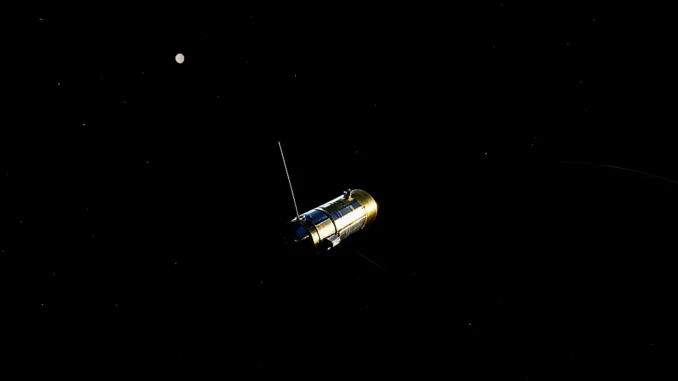
On November 18, Voyager 1 is expected to be about one light-day from Earth—roughly 25.9 billion kilometers away. A light-day is the distance light travels in 24 hours. At that range, a radio signal takes about a day to travel one way between Earth and the spacecraft.
This delay affects how mission teams communicate with Voyager 1. A command and the spacecraft’s response can require roughly two days or more, so operators cannot rely on immediate feedback. The milestone highlights the practical challenges of managing a spacecraft operating far beyond the planets while it continues to send measurements from interstellar space.
November 24 Supermoon
The full Moon on November 24 is described as a supermoon because it occurs when the Moon is near the closest part of its elliptical orbit around Earth. A supermoon can appear up to about 14% larger and 30% brighter than a full Moon near its farthest point, although the difference can be difficult to judge without comparing the two directly.
For a striking view, watch the Moon rise near the horizon and include a familiar object—such as a building, tree, or ridge—in the frame. This creates a sense of scale and makes a useful landscape photograph. If you photograph the lunar surface through a telescope, use a relatively short exposure to avoid washing out its details.
Frequently Asked Questions About November Skywatching
What is the best time to watch a meteor shower? The hours after moonset and before sunrise are often most productive because the sky is darker. Check the local moonset time for your observing site.
Do I need a telescope to see meteor showers? No. Use your unaided eyes so you can watch a wider area of the sky.
Can I see meteors when there are some clouds? You may still spot meteors through gaps in partial cloud, but clouds block part of the sky and reduce your chances. A mostly clear forecast offers the best conditions.
How should I keep track of meteors? Note the start and end time of each observing interval, the number of meteors, and any striking details such as brightness or color. These observations help you compare activity over the course of the night.
How to Prepare for a Night of Skywatching
- Check the weather and the Moon’s schedule before choosing a night.
- Travel to a location away from bright streetlights and buildings.
- Dress for cold conditions and bring a blanket or reclining chair.
- Give your eyes at least 30 minutes to adapt to darkness.
- Watch with a wide, unobstructed view rather than relying on a telescope.
- If taking photos, use a tripod and test your exposure settings before the event.
- Keep simple notes on what you see and when you see it.
November’s highlights reward both casual observers and dedicated skywatchers. The Taurids may deliver occasional fireballs, the Leonids offer a stronger meteor display, and Mars and Jupiter will appear close together before sunrise. A clear forecast, a dark location, and patient viewing will make these events easier to enjoy.





Be the first to comment