
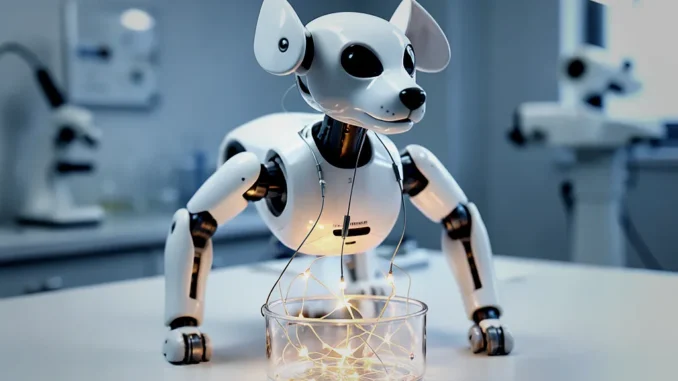
A biochip that connects living neurons to a robot links biological electrical activity with electronic control. In a typical setup, researchers grow neurons on a silicon platform equipped with microelectrodes. The electrodes record neuronal signals and deliver electrical stimulation, while software translates activity into commands for a robot. Feedback from the robot’s movement can then influence the signals sent back to the neural culture, creating a closed-loop system.
How Does a Neuron-Controlled Robot Work?
The system converts signals in both directions. First, microelectrodes measure electrical activity from the neuron culture. A computer processes those recordings and maps selected patterns to engine commands. The robot moves, sensors detect changes in its surroundings, and the control system may use that feedback to stimulate the neurons. Over repeated interactions, researchers can study how the biological network responds to changing inputs.
- Record: Microelectrodes detect electrical activity from the cultured neurons.
- Translate: Software filters and interprets the recorded signals.
- Act: The robot receives motor commands based on the processed activity.
- Respond: Sensors and feedback provide information about the robot’s movement and environment.
What Could Living Neurons Add to Robotics?
Biological neural networks can change their connections in response to activity, a property known as synaptic plasticity. Researchers are investigating whether this adaptability could help robots respond to unfamiliar conditions without relying entirely on fixed, pre-programmed rules. Neuron-based systems may also offer a different approach to low-power information processing, although any energy advantage must be measured across the entire setup—including cell maintenance, stimulation, sensing, and computing.
Potential applications include robots that navigate unpredictable environments, such as search-and-rescue machines, and systems that must operate with limited power. These are research possibilities, not established commercial capabilities. A cultured neural network does not automatically learn a useful task; researchers must carefully design the interface, feedback, and training process.
What Have Early Experiments Demonstrated?
Early biohybrid experiments have shown that researchers can connect living neural cultures to electronic devices and use recorded activity in physical control systems. Such demonstrations establish the feasibility of a biological-electronic interface. They do not, by themselves, prove that a neuron-controlled robot can learn reliably, outperform conventional controllers, or operate independently for long periods.
Results depend on the cell type, culture conditions, electrode design, signal-processing methods, and task. Claims about adaptation time, signal stability, or energy savings should therefore be tied to specific published experiments and their measurement methods rather than treated as universal benchmarks.
What Are the Main Technical Challenges?
- Keeping cells healthy: Neuron cultures need controlled conditions, including suitable nutrients, temperature, and contamination prevention. Changes in cell health can affect recorded signals.
- Reading and stimulating precisely: Electrode arrays must capture useful activity and deliver stimulation without disrupting the culture. More electrodes do not automatically provide clearer or more selective control.
- Making results repeatable: Biological networks vary between cultures and can change over time. Researchers need methods that produce dependable behavior across experiments.
- Separating biological and computational work: Signal filtering, safety controls, and motor coordination still require electronic hardware and software. The biological component is only one part of the system.
How Could Researchers Improve These Systems?
- Improve culture maintenance: Develop reliable protocols and devices that keep neural cultures viable and functional over longer periods.
- Refine the electrode interface: Increase the ability to record relevant signals and stimulate specific parts of a culture.
- Use hybrid control: Combine neural activity with conventional algorithms so that software can handle predictable tasks while the biological component is only one part of the system.
component is studied for adaptive responses.
Test performance rigorously: Compare systems against standard controllers using clearly defined tasks, repeated trials, and measures such as accuracy, response time, reliability, and total energy use.
Add safeguards: Set limits on motor commands and provide a reliable fallback controller if signals become unstable or unclear.
Does a Neuron-Based Biochip Have Consciousness?
A cultured neural network is not equivalent to a human brain. Its activity alone does not establish consciousness, perception, or subjective experience. Questions about the capabilities and ethical treatment of increasingly complex neural cultures remain under discussion, so researchers should use transparent oversight appropriate to the work.
When Could Biochips Appear in Commercial Robots?
There is no dependable timeline for commercial use. Researchers must first demonstrate stable cultures, repeatable control, practical maintenance, and a clear advantage over conventional electronics for a specific task. Until those requirements are met, neuron-based robot control remains an experimental research area rather than a ready-to-deploy technology.
Bottom Line









Be the first to comment